
All that glitters isn't green: The truth about lab-grown diamonds
‘Eco-friendly,’ ‘Ethically sourced,’ ‘A new and more sustainable alternative.’
Make a quick Google search for ‘lab-grown diamonds’ and these are the statements keen for your attention, often thrust to the fore by paid advertising.
It’s no secret that the natural diamond industry, with its imperialistic roots, remains fraught with exploitation. To refer to a lab-grown diamond as ‘ethical’ in comparison is not totally unjustified. Avoiding the requirement for further mining and a new supply chain altogether, lab-grown diamonds are an appealing opportunity for those who wish not to contribute to extractive activities.
With an estimated 15 to 20 million carats of diamond lab-produced in 2025 alone, however, this alternative is by no means a modest operation. Though the official figure is not tracked by a central registry, there are believed to be thousands of companies now manufacturing diamonds worldwide. Consumers and jewellers are not faced with a straightforward solution to their concerns about mining, but myriad voices vying for attention with competitive prices and echoed promises of low environmental impact.
In 2020, The Economist estimated that lab-grown diamonds would account for roughly 80% of the global diamond market by 2050. Boasting a growth rate of approximately 300% between 2020 and 2024, the lab-grown diamond sector is now a booming subindustry in its own right.
But, like all shiny new arrivals, we must interrogate the nuance behind the sparkle. If we are to embrace this new marvel as an established aspect of the jewellery industry, it’s crucial that we differentiate between those making tangible efforts to minimise their environmental impact and those operating quietly beneath a greenwashed guise. If all that glitters is not gold, then all that sparkles is not a truly sustainable lab-grown diamond.
The state of the diamond industry: an honest assessment
The diamond industry, like many others, is rooted in colonialism and imperialism. When civil war tore through Sierra Leone in the 1990s, armed conflict was concentrated in and around the country’s diamond districts. The mass devastation that followed cast a spotlight on the diamond trade’s secretive means as never before. The estimated portion of the market that conflict stones accounted for has since dropped from 20% to a reported 1% - but for many consumers and industry players, there remains considerable room for improvement.
Whilst our ultimate stance against neocolonialism places us at odds with large-scale extractivism, to some degree it is reassuring to see large diamond companies, once driven solely by profit, beginning to invest in communities and land. Forward-thinking steps are being taken from all angles: blockchain developments, widespread traceability efforts, and aboriginal representation in decision-making boards addressing issues of displacement, gender and identity. The revolution will not happen overnight, but the direction of travel is promising.
“I’m optimistic by nature. I believe we are in a great position to make everlasting improvements, starting at the most fundamental end of the supply chain: the mines and miners themselves.” - Arabel Lebrusan, Creative Director
How are lab-grown diamonds produced?

Lab-grown diamonds are cultivated using technology that simulates the geological processes by which natural diamonds are formed. The result is stones that are chemically, physically and optically identical to those grown beneath the earth’s surface.
There are two processes used to produce them. A High Pressure-High Temperature (HPHT) diamond begins as a small diamond seed placed in carbon, before being exposed to temperatures of around 1,500°C and pressurised to approximately 1.5 million pounds per square inch. The carbon melts and forms a diamond around the starter seed before being cooled into a pure carbon diamond.
A Chemical Vapor Deposition (CVD) diamond, meanwhile, begins as a slice of diamond seed placed in a chamber and heated to 800°C. The chamber is filled with gases ionised into plasma using technology similar to microwaves or lasers; the ionisation breaks the molecular bonds and the carbon adheres to the seed before crystallising.
The intense pressure and substantial machinery required by HPHT demands greater volumes of energy than CVD, which runs on moderate temperatures, low pressure and smaller equipment. The choice of production method - and crucially, the energy source powering it - is where the sustainability story of any given lab-grown diamond begins.
What are the sustainability concerns around the production of lab-grown diamonds?

China is the world’s largest producer of lab-grown diamonds, accounting for over 40% of man-made stones worldwide. As a nation, China sources 55% of its power from coal and just 20% from renewable hydro sources. In India, another major producer, 75% of grid power comes from coal. Singapore, home of lab-grown diamond industry leader IIA Technologies, uses little renewable energy at all.
The vast amount of power required to create a diamond in a lab can lead to significant carbon pollution when the energy source is dirty, with greenhouse gas emissions thought to be three times greater for some lab-grown diamonds than their mined counterparts. There remains very little transparency around the sustainability claims of most lab-grown diamond companies, and explicit data on their energy usage is virtually impossible to obtain. What is clear is that the majority rely on heavy-duty machinery powered by mostly non-renewable energy.
Environmental efforts: Carbon offsetting

Unfortunately, certain carbon emissions are simply impossible to avoid. This is particularly true of industries like the lab-grown diamond trade, for which factory equipment is an inextricable aspect.
Meanwhile, carbon offsetting enables a business to pay another entity to remove a given quantity of greenhouse gases from the atmosphere. This could take the form of financing a wind turbine generator to displace fossil fuels on the power grid or planting a body of trees to sequester CO2. For example, we at Lebrusan Studio are planting 10 trees in Colombia for every piece of jewellery we sell.
Carbon offsetting is a controversial approach to environmental sustainability because it doesn’t eliminate the issue of carbon emissions in the first place; only attempts to negate them at a later stage. However, advocates argue that carbon offsetting offers enormous potential to combat climate change, preserve nature and direct money to parts of the planet that need it most.
In July 2017, lab-grown diamond company The Diamond Foundry announced its status as the world’s first carbon-neutral diamond producer. To achieve its certification as a CarbonNeutral® company, The Diamond Foundry worked with Natural Capital Partners, the experts on carbon neutrality and climate finance. It achieved net zero greenhouse gas by undergoing an independent assessment of the CO2 emissions produced by its operations, then funding sustainable development and renewable energy projects around the world.
Following suit, Washington D.C.-based lab-grown diamond producer Latitude later announced in June 2021 that it’s the first company to be Sustainability Rated by the SCS Global Services’ Jewelry Sustainability Standard and achieve the ‘Fifth C’ of Climate Neutrality. Through strategic sustainability investments and improvements to the production process, Latitude now offset, mitigate and reduces its environmental impact by eighteen times.
Leading by example, these companies demonstrate the opportunities available to any diamond industry player who wishes to leave a smaller footprint in its wake. There are ways to operate more sustainably; it’s just a matter of inclination.
What to look out for: Substantiated claims

In our current state of climate emergency, with conscious consumerism firmly on the rise, it has become the priority of many jewellery companies to appease ethically-conscious consumers with the words they want to hear. ‘Ethical’, ‘green’ and ‘eco-friendly’ are buzzwords now cemented in the lexicons of many lab-grown diamond companies - but as we know, this language is often fuzzy.
When shopping for a lab-grown diamond, pay attention to brands speaking in specific terms: quantifying their sustainability claims with tangible data. Do they explain the process by which their diamonds are formed? Are they doing anything to tackle the carbon footprint left behind by that activity? If so, they will probably be shouting about it. Lab-grown diamond companies making genuine efforts offer substantiated claims and seals of approval from organisations such as CarbonNeutral, SCS Global Services and B Corp.
A note on lab-grown coloured diamonds

Natural fancy colour diamonds in vivid yellows, pinks and blues are extraordinarily rare, forming over the course of up to 3.3 billion years through exposure to radiation, underground gases and specific chemical elements. Their rarity has historically made them the preserve of society’s upper echelons.
Laboratories can now cultivate fancy coloured diamonds by simulating and treating the crystallisation process - and the results are chemically and optically identical to their natural counterparts, available in a matter of weeks rather than billions of years. Unlike natural fancy colour diamonds, these are accessible in both price and scale.
“From a jeweller’s perspective, I’d be lying if I said I wasn’t mesmerised by the sizes and colour palettes available to us when we delve into the realm of lab-grown stones.” - Arabel Lebrusan
When it comes to colourless diamonds, we prefer recycled or artisanally mined conflict-free stones for the sake of the Doughnut. We appreciate, however, that natural fancy colours are simply out of reach for most. On the occasion that a client approaches us with a vision of a techn, lab-grown coloured diamonds are a genuinely exciting opportunity – an affordable access route to a technicolour world of design possibilities.
Buying a diamond: the five Cs
Whichever type of diamond you choose, understanding how diamonds are graded can assist you in budgeting, decision-making and navigating conversations with your jewellery designer.
The 4 Cs grading system has been the universal language of diamonds for over 80 years, developed to help buyers navigate the natural variation inherent in mined diamonds - the fact that no two stones formed beneath the earth’s surface are identical, and that quality therefore spans a spectrum. When it comes to lab-grown diamonds, however, this variation largely disappears. Gem-grade lab-grown diamonds are manufactured under precisely controlled conditions, engineered from the outset to achieve the characteristics the market values most: colourless or near-colourlessness, minimal inclusions and perfectly symmetrical, optimised cuts. This means the vast majority of lab-grown diamonds sold as jewellery score well across the 4 Cs almost by default.
Here at Lebrusan Studio, we discuss diamonds with reference to our own 5 Cs system - though this grading system’s relevance depends considerably on which type of diamond you’re actually buying. We wish to preface this section by explaining that the 5 Cs can be a useful framework, but developed to grade newly mined, modern brilliant-cut diamonds - and reflect a specific set of aesthetic values that we at Lebrusan Studio actively question – it’s not the whole story. We strongly believe that the most beautiful diamonds are not those which score highest on a grading chart, but those that resonate: with history and character that you feel proud to carry forward as part of your jewellery.
1. Cut
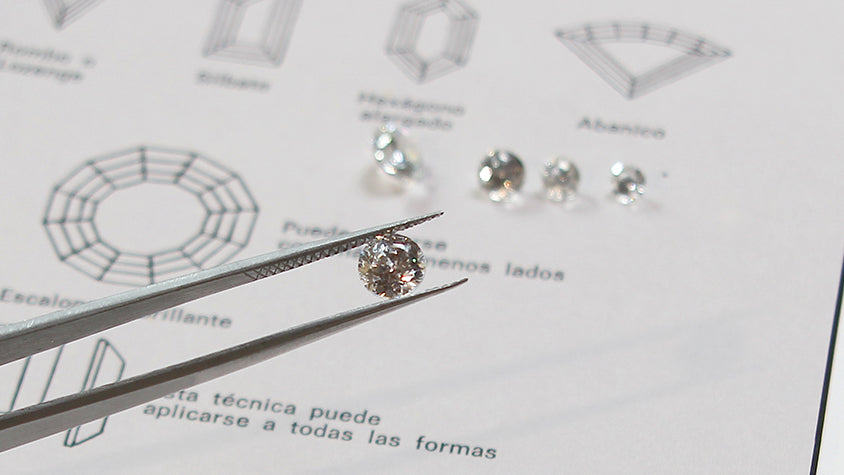
Cut is the only characteristic of a diamond not influenced by nature. The way a diamond’s facets are angled and sized, either by hand or by machine, determines its shape and how light reflects and exits the stone, producing its characteristic brilliance and fire. A ‘poor’ cut compromises sparkle regardless of how fine the other qualities are. Triple Excellent (EX EX EX) is the highest cut grade available for modern brilliant-cut stones.
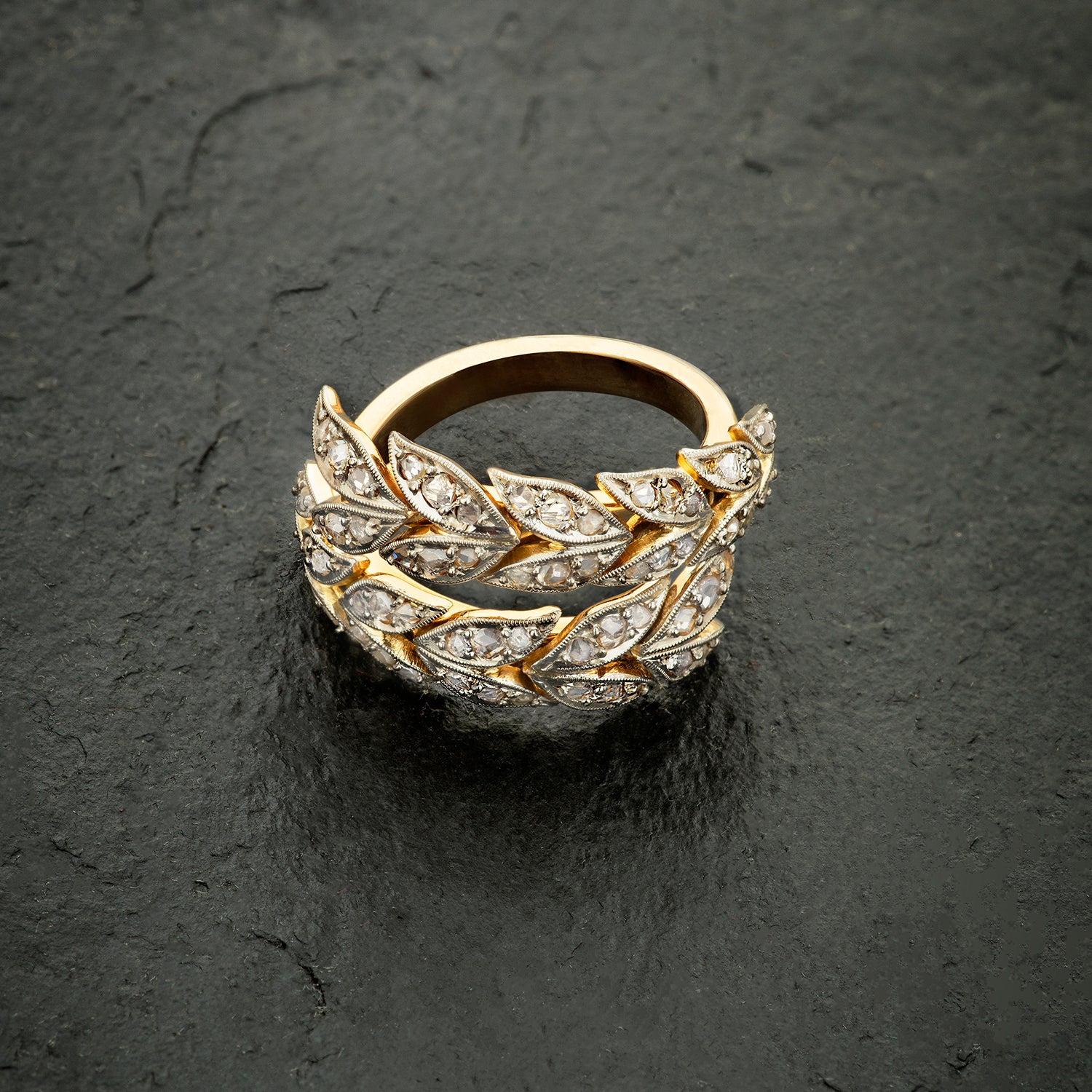
Antique diamonds such as old mine cuts, old European cuts and rose cuts predate the standardised 4 Cs grading system entirely, their facets shaped by hand rather than machine. This means they will never achieve a Triple Excellent grade, and nor should they. Their slightly irregular facets and soft, candlelit glow are not flaws but fingerprints of the craftspeople who cut them, and the reason we champion them. If a grading certificate is available for a reclaimed old-cut stone, treat it as a guide rather than a verdict.
2. Colour
Historically, the most valuable diamonds are colourless. Jewellers grade them on a scale from D (entirely colourless) to Z (visibly yellow or brown). D, E and F are colourless; G through J are near-colourless and highly desirable. The most popular choice sits anywhere in the spectrum of E to H.
The grading scale was designed to serve a particular vision of perfection - one that prizes the absence of colour above all else. We see it differently. Colour in diamonds is caused by tiny structural anomalies that absorb specific wavelengths of light, or by distortions in the diamond's crystal structure during formation. A diamond with a warm golden hue or a rich brown tint carries the memory of the earth it came from. It’s worth pointing out, at this stage, that lab-grown diamonds simply cannot emulate this unique character and capacity for storytelling.
3. Clarity
Most diamonds contain tiny natural inclusions - nature’s fingerprints - often visible only under magnification. As long as a stone is graded SI1 (Slightly Included 1) or better, inclusions are invisible to the naked eye. VS1 or VS2 (Very Slightly Included) offers an excellent balance of quality and value for those prioritising a clean appearance.
The clarity scale, like the colour scale, encodes a particular set of values that we don’t always subscribe to religiously. A heavily included diamond is not a lesser diamond, but one that is distinctive and honest. Every cloud, feather and crystal trapped inside the stone is a record of its journey: the heat, pressure and time it took to form it.
With their striking galaxies of inclusions, we’re particularly drawn to salt and pepper diamonds; their ‘imperfections’ formed over billions of years with no human intervention whatsoever. Each completely unique, we view them as miracles gifted to us by Mother Nature. Perhaps undervalued by a conventional grading report, we believe ‘perfectly imperfect’ diamonds are some of the most beautiful and meaningful materials we work with.
4. Carat
The carat is the measure of a diamond’s weight, and thus its size. One carat equals 0.2 grams. It’s worth remembering that carat weight and visual size are not the same thing: a well-cut stone can appear larger than a heavier one with a poor cut, and the shape of the stone affects how the weight is distributed across its face.
5. Certificate
A certificate from a recognised laboratory such as the Gemological Institute of America (GIA) confirms a diamond’s grades across the four Cs above. In some cases, a certificate also confirms provenance: a Canadamark certificate, for example, features a maple leaf and microscopic identification number laser-inscribed onto the stone, guaranteeing full traceability to a Canadian mine. When shopping for a newly mined diamond, we recommend asking for a form of certification that corroborates both quality and provenance in writing.
A grading certificate for a lab-grown stone is still worth having, because it confirms the stone’s specifications - but it tells you far less about the quality than it would a natural diamond, because there is far less variation to account for. This near-uniformity is, in one sense, a selling point: you’re unlikely to inadvertently purchase a poor-quality lab-grown stone. However, it also means the 4 Cs, as a tool for comparison and decision-making, become somewhat redundant. When most lab-grown diamonds look and grade almost identically, the more meaningful questions ask not about the stone’s colour or clarity, but about the conditions under which it was produced, the energy source that powered its creation, and whether the company behind it is making genuine efforts to reduce its environmental footprint. In other words, this fifth C is the most important consideration when choosing a lab-grown diamond because it helps us to assess its legacy beyond its quality.
Older and reclaimed stones don’t always come with a grading certificate - particularly antique old-cut stones, which predate modern laboratory grading.
Our position on lab-grown diamonds

Looking ahead, we foresee the lab-grown diamond market segmenting into more and less sustainable options. The latter will continue churning out diamonds via energy-intensive processes, making little effort to counteract the negative effects and capitalising on the widespread assumption that lab-grown simply means ethical. The former will focus on carbon neutrality, renewable energy and vertically integrated supply chains.
At Lebrusan Studio, we currently offer three diamond options across our collections: recycled natural diamonds, newly mined natural diamonds with certificates of origin, and traceable lab-grown diamonds. We offer three options because ‘ethical’ is no longer one pigeonhole. A young engineer might choose a lab-grown diamond as a nod to her career, whilst a history enthusiast might prefer a recycled old-cut stone for its uniqueness and charm. As a jewellery design studio, our role is to lend you the knowledge to choose with confidence.
As consumers, it’s our responsibility and our privilege to dig beneath the surface in search of those diamonds in the rough.

Written by Arabel Lebrusan