
Old cut vs. brilliant cut diamonds: What's the difference?
Framed by historical context, this blog post answers the question "What is an old cut diamond?," explaining how this enduring faceting style differs from the familiar round brilliant cut of today and exploring the environmental and socioeconomic benefits of choosing one over the other.
If you’ve spent any time perusing our website, you’ve probably noticed the prevalence of old cut diamonds across our collections. If you’re new to the term ‘old cut’, you might be wondering what exactly we mean by it. To some extent, the clue is in the name; as far as precious materials go, old cut diamonds tend to be pretty old. There’s more to it than that, however. When compared to the round brilliant cut diamond – the old cut’s contemporary equivalent and by far the most popular choice amongst engagement ring shoppers today – there are a variety of interesting differences, many not immediately obvious to the untrained eye.
A history of old cut diamonds
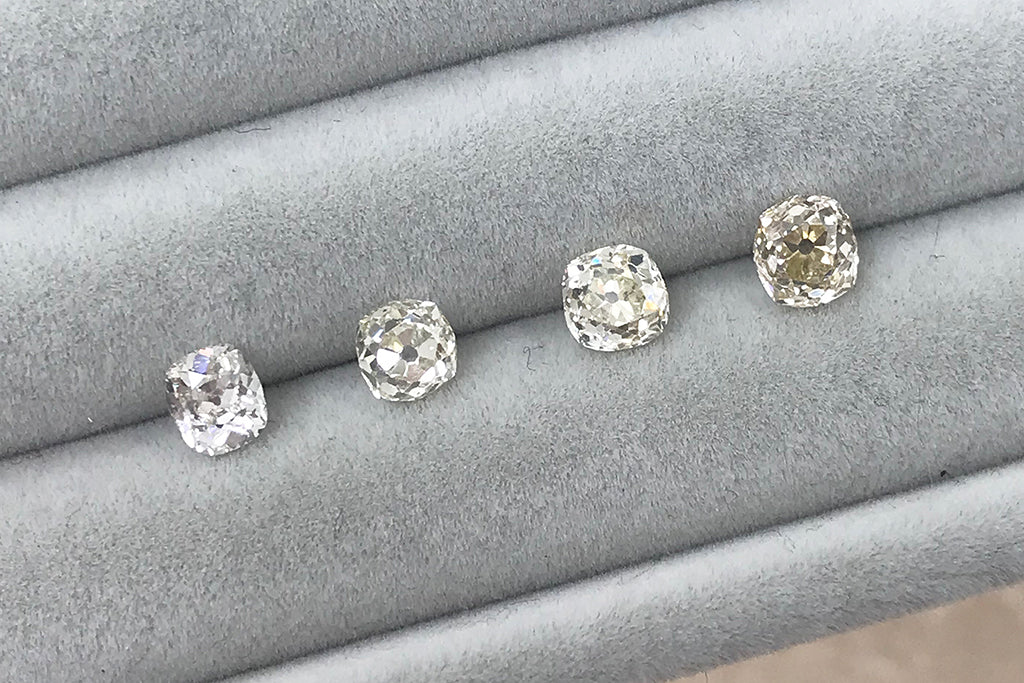
A quartet of old cushion cut diamonds, similar to the one set in our ready to wear Athena engagement ring
The old mine cut (or cushion cut) enjoyed its heyday from the early 18th century to the latter end of the 19th century, and is now most commonly found in jewellery of the Georgian and Victorian eras. It exists as an evolution of the 33-facet cushion-shaped Peruzzi cut of the 1700s and is considered the earliest version of the modern brilliant cut, as the first to utilise 58 facets. It’s thought that the term ‘old mine cut’ entered the common vernacular in the late 1800s, at a time when diamond production in Africa began to eclipse that of the ‘old mines’ of Brazil and India. Any diamond originating from Brazil or India and cut with 58 facets and a squarish shape was labelled an old mine cut.
Early diamond cutters formed old mine cut diamonds with the use of other diamonds as cutting tools, since the diamond is the hardest known natural substance on earth and thus only capable of being sliced by a fellow diamond. Naturally, this laborious technique of rubbing two diamonds together by hand resulted in dimensions that varied from stone to stone. Every old mine cut diamond is therefore totally unique; often endearingly lumpy and always bursting with personality.
The Victorian era of the late 1800s was one of progression, an Industrial Revolution ushering in a number of inventions that would go on to change the world; from the automobile to electricity and indoor plumbing. Unsurprisingly, diamond cutting advanced significantly during this time. The introduction of the steam-powered diamond lathe in 1874 helped to refine and standardize the way diamonds were cut, offering cutters a little more precision and control. Not only did this give rise to the round shape, but it enabled cutters to cleverly modify the proportions of those 58 facets, creating greater scintillation. A precursor to today’s round brilliant-cut, this interpretation is now known as the old European cut.
At Lebrusan Studio, ‘old cut’ is a blanket term that we use to refer to any sparkler that originated from within this epoch. For design purposes, round old European cut diamonds are those that we tend to use most often.
Old cut diamonds vs. new diamonds

SHAPE
When viewed from above, old mine cut diamonds are square with slightly rounded corners, whilst the old European cut is almost perfectly round.
Though the invention of steam-powered bruting machines in the late 1800s enabled cutters to begin cutting round diamonds on an industrial scale, it was not until the early 1900s when motorized diamond saws gave rise to the perfectly circular form of the brilliant cut.
CUT
The old cut diamond is usually characterised by a small top facet – or ‘table’. The crown, which is the portion of the stone above its widest point, is usually a little taller than that of the modern round brilliant cut. Meanwhile, the pavilion depth – the portion of the stone below its widest point – is generally deeper.
‘Culet’ is the name for the very bottom of a diamond. The rudimentary cutting techniques used to produce most old cut diamonds made it virtually impossible to create a pavilion with uniform facets that tapered at a straight angle. Unlike the modern round brilliant cut, whose expertly pointed tip is the product of advanced cutting technology, old cut diamonds rarely end in a nib. Instead, their culets are flat; a feature that diamond cutters once believed would enable more light to enter the stone, thereby increasing its brilliance. This flat culet often appears as a dark circle, sometimes mistaken for a hole or inclusion. In fact, it’s one of the most distinctive attributes of and old cut diamond in comparison to a modern round brilliant cut stone. The old cut’s flat culet is classed as a 58th facet, whilst round brilliant cut diamonds are defined by only 57.
There’s something incredibly romantic about the image of an artisan sat at his bench, carefully cutting a diamond by hand. The unique shape, size and facet placements of each old cut stone give it a distinctive and unrepeatable personality. Whilst round brilliant cut diamonds offer serious surface sparkle, old cut diamonds scintillate deeply, dancing under candlelight and drawing the eye inwards. For those who are deterred by the loud bling of modern cuts, the old cut is a gentle and sensitive alternative.
SYMMETRY
Because old cut diamonds were faceted by hand or basic machinery, they lack the uniformity of modern diamonds. Though precise symmetry is a basic expectation of the round brilliant cut, an irregular shape or misaligned facet are not uncommon features of old cut stones.
Are old-cut diamonds more ethical than modern diamonds?
The case for old cut diamonds: A circular economy in action

By definition, an old cut diamond is a hand-faceted diamond predating the machine-cut diamonds of today; generally hailing from the late 19th century or early 20th century. There are a number of variations of the old cut diamond; you can learn more about the nuances of these cutting styles here.
Old cut diamonds are often reclaimed from antique or vintage jewellery, offering the opportunity to create new pieces of diamond-set jewellery without the demand for any newly-mined diamonds. This alone makes them a powerful example of circular economy principles: using what’s already above ground before extracting more from the Earth.
Environmentally speaking, this is a clear win. It’s no secret that industrial diamond mining contributes to significant land degradation, biodiversity loss, deforestation and carbon emissions, not to mention the rapid consumption of a finite natural resource. Whilst small-scale diamond mining is undoubtedly less strenuous on our planet than the operations of ginormous open-pit mines, the artisanal diamond sector is not entirely blameless either. Sadly, there are still a number of informal artisanal diamond mines around the world responsible for contaminating surrounding land and waterways, air pollution, and erosion.
Choosing an old cut diamond is a simple means of not contributing to that environmental footprint, instead extending the life of a finite natural material already in circulation. From a Doughnut Economics perspective, old cut diamonds sit comfortably within the ecological ceiling, not compromising Planet Earth’s ability to sustain life for future generations. They are, in essence, part of a regenerative cycle - something Raworth calls us to prioritise as we reimagine how goods and materials can circulate in the global economy.
The case for newly mined artisanal diamonds: Socioeconomic benefits for people
 A’s bespoke engagement ring with a 0.8ct artisanal Ocean Diamond
Newly mined diamonds are the livelihood of roughly 40 million artisanal and small-scale miners (ASMs) and another 150 million people indirectly dependent on the industry. The majority of these miners and their communities are based in the Democratic Republic of Congo (DRC), Sierra Leone and Tanzania.
For these miners, income from the diamond trade supports their families, communities and in some cases entire local economies. To eliminate demand for newly mined diamonds altogether would be to cut off a vital source of income for these workers - many of whom already live close to or below Raworth’s social foundation. In this light, the ethics of diamond consumption cannot be separated from questions of global equity and justice.
As touched upon previously, many of these ASM miners work informally, outside of regulated supply chains. Sadly, this leaves them vulnerable to exploitation in the form of unfair and unreliable pay, unsafe working conditions and nefarious middle-men. The refusal to engage with newly mined natural diamonds on this basis will not solve the problem; only exacerbate it by driving prices down and further compromising the stability of legitimate supply chains. Countries like DRC, Sierra Leone and Tanzania are rich in mineral wealth. Currently, the benefits of this mineral wealth are largely reaped by just a privileged few. As advocates for ethical jewellery, it’s our responsibility to push for greater formalisation in the artisanal diamond mining sector to ensure mining communities are better protected.
In other words, the global demand for mined diamonds plays an important role in driving an equitable future for those who rely on artisanal diamond mining to survive. Old cut diamonds tread lightly on the planet, but alone they do not serve these people. There is often tension between reducing environmental harm and making a positive socioeconomic impact, but we at Lebrusan Studio are here to support you in making a meaningful decision that aligns with your ideal worldview.
Our love affair with old cut diamonds
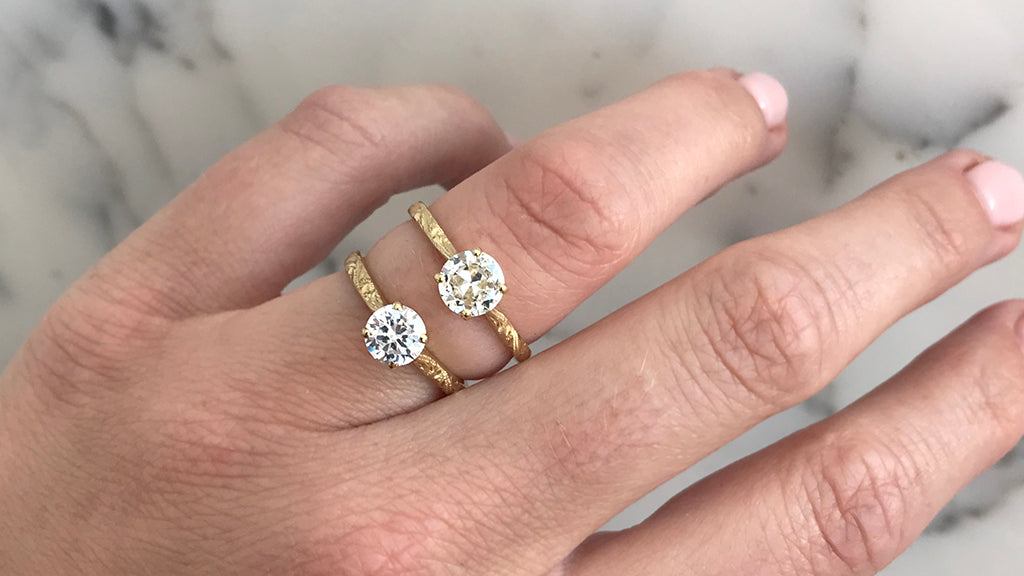
 Josh's bespoke engagement ring, set with a reclaimed 0.6ct European old cut diamond
Here at Lebrusan Studio we’re passionate about minimising waste and reducing consumption; that's why we love to champion beautiful metals and gemstones that are already above-ground. Reclaiming old cut diamonds not only enables us to fashion new jewels with minimal impact on the environment, but to preserve legacies. Whether a remodelled family heirloom or a contemporary engagement ring set with an intriguing vintage centrepiece, jewellery incorporating pre-loved materials is jewellery that tells a thousand stories of lives well lived.