
Does my wedding ring need to be the same metal as my engagement ring?
As you embark on your hunt for the wedding band you'll wear forever, this post will help you choose a metal that's a suitable match for your engagement ring, whether that's a question of hardness, colour or overall style.
Can platinum and gold be worn together?
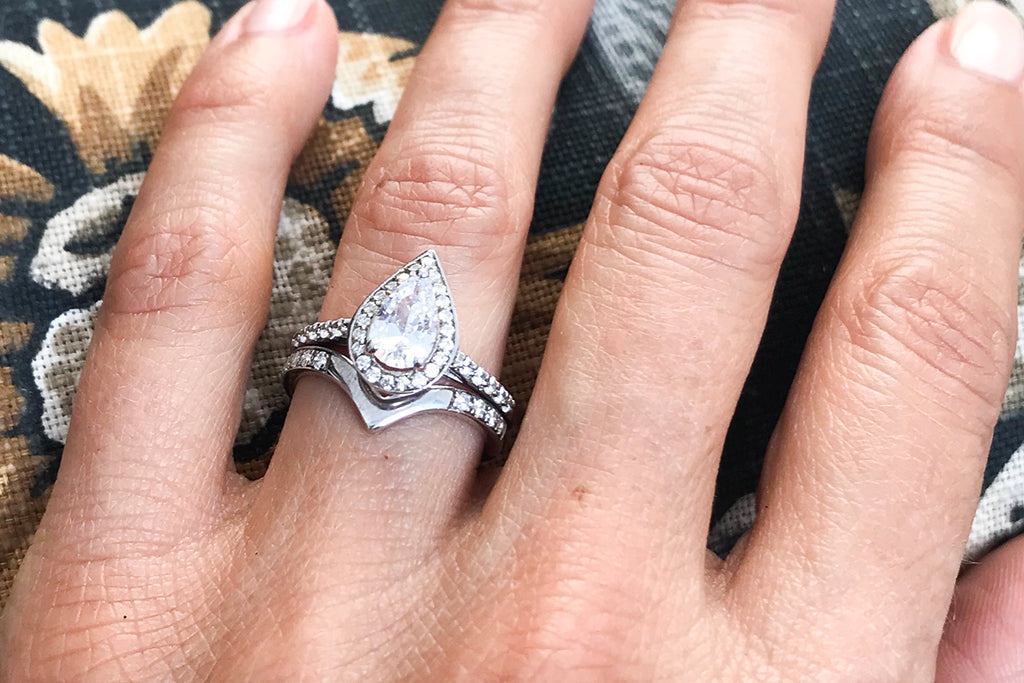
Our platinum Tethys engagement ring and Wishbone Diamond Crown wedding band
This is one of our most frequently asked questions. In the context of ‘forever’ jewellery like engagement rings and wedding bands, the short answer is no.
When picking out your wedding ring, there's one rule to keep in mind. Its metal must match your engagement ring in hardness, so that neither ring scratches the other.
For easy reference, here's how the most common ring metals compare on the Mohs Scale of Hardness.
|
Metal |
Mohs Hardness |
|
Sterling silver |
2.5 - 3 |
|
18ct yellow gold |
2.75 – 3 |
|
18ct white gold |
2.5 – 3 |
|
18ct rose gold |
2.75 – 2.8 |
|
Platinum |
4 - 4.5 |
|
Palladium |
4.75 |
|
Titanium |
6 |
|
Tungsten |
7.5 |
If you'd like your rings to look fresh-faced for as long as possible, aim for the same metal, or at least two metals of a very similar hardness.
Is it okay to mix metal colours? Can I wear a white gold engagement ring with a yellow gold wedding band?
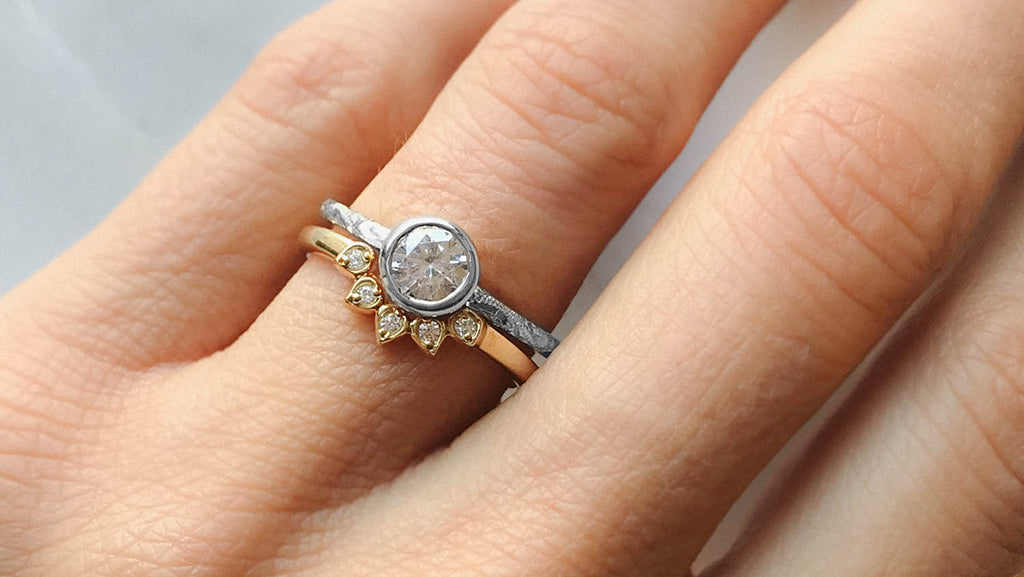
 Our 18ct white gold Hestia engagement ring with our yellow gold Teardrop Diamond Tiara wedding band
Metal hardness settles what's practical. Beyond that, the aesthetic choice comes down to what suits you, and what you enjoy. Gone are the days when traditional fashion etiquette expected us to pick one lane and stick to it.
In fact, we at Lebrusan Studio appreciate the combination of metal colours for its symbolism. Cool white on warm yellow is a unity of opposites, merging contrasting energies to represent the joining of two distinct paths. Pairing a yellow gold engagement ring with a white gold wedding band illustrates the evolution of time; a stack of rings built step-by-step, moment by moment.
If you’re torn between whether to stick or twist, start by looking at the jewellery you already wear day-to-day. Have you only ever gravitated towards one metal colour? Although traditions are evolving, many people simply like their jewellery to match, so if you’re already deeply settled into a single colour scheme, it’s a safe bet to continue on that path.
If your jewellery collection is more of a mixed bag, with silver and gold tones combined freely, let your engagement ring’s gemstone guide your metal choice instead. The fire and saturation of a red ruby, for instance, is set off wonderfully by the warmth of yellow gold; whilst cooler metals like white gold or platinum tastefully accentuate the brilliance of a colourless diamond.
If jewellery isn't something you wear often, skin tone might be a useful starting point. Cool, silver toned metals like platinum and white gold tend to suit fair skin, whilst warmer and darker skin tones are often complemented beautifully by yellow or rose gold.
None of this is a rule; Only a starting point. We’re strong advocates for leading with instinct. The metal that feels most like you is always the right one.
Caring for white gold over time
 An 18ct white gold trilogy engagement ring and Scrolls Engraved wedding band
White gold is generally an alloy of around 75% pure yellow gold and 25% other metals like palladium, included to give the yellow metal its silvery white hue. Even with the presence of these cool-toned metals, white gold still carries a faint yellow tinge, which is why it's usually plated with rhodium to complete the piece with a fully white finish.
Rhodium plating isn't designed to last forever. It wears away slowly with daily exposure to the elements, gradually revealing the warmer tone beneath. The rate at which this happens varies from piece to piece, depending on numerous factors from jewellery care to surface design, day-to-day activity and even the unique acidity of the wearer's skin.
It’s worth pointing out here, however, that the presence of yellow gold or rose gold will not accelerate the wear-down of white gold’s rhodium plating. 18ct gold alloys, regardless of colour, are noble metals with very close electrochemical potentials. In other words, they don’t create the active galvanic cell needed to corrode or strip rhodium. The inert contact of two 18ct gold rings creates only mechanical rubbing, not chemical degradation. This means there is no more risk in pairing an 18ct white gold with a neighbouring 18ct yellow or rose gold ring, than there is pairing two 18ct white gold rings.
We recommend having white gold rings replated with rhodium roughly once every couple of years to keep them looking crisp and white. It's a quick, straightforward process offered by most jewellers.