
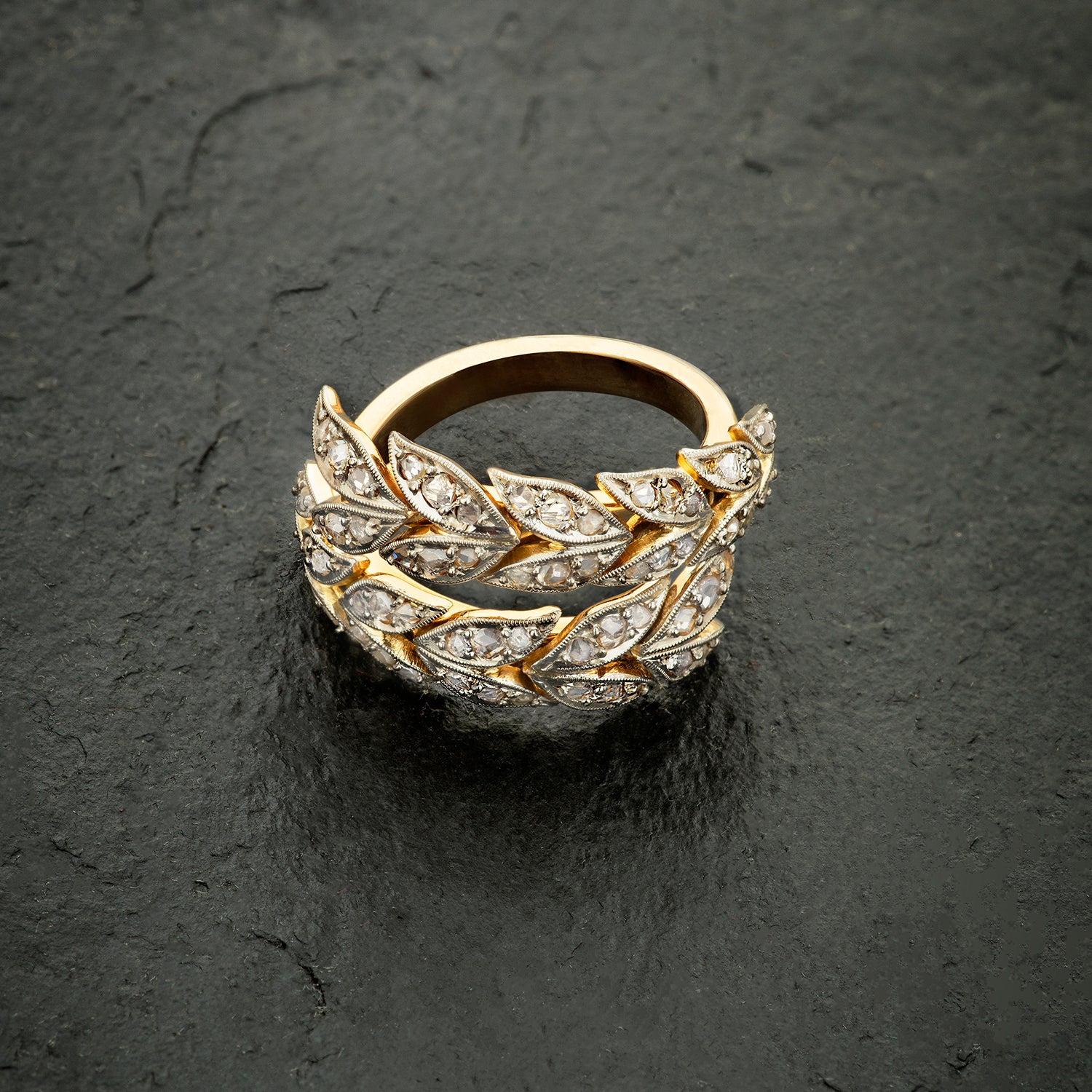
Article: Everything you should know before buying a champagne diamond ring
Everything you should know before buying a champagne diamond ring
When De Beers introduced its legendary slogan ‘A Diamond is Forever’ in 1947, the precedent was set: a colourless diamond solitaire was the symbol of lifelong love and commitment. Fast-forward to today, however, and an increasing number of couples are exploring a technicolour dreamworld beyond the white diamond standard. Among the most compelling destinations is the champagne diamond.
If you have found yourself charmed by the sumptuous off-white hue and celebratory connotations of this alternative to the classic colourless diamond, you might have a few questions before committing to that once-in-a-lifetime heirloom jewel. This post is your one-stop guide to the champagne diamond: from the science behind the shade to its history, pricing, durability and why we love it so much.
What is a champagne diamond?

Ready-to-wear Fancy Athena ring set with an oval-cut champagne diamond – from the archives
A champagne diamond does exactly as it says on the tin; it’s a diamond with a naturally yellow-brown tint that resembles the colour of champagne.
Generally, any diamond that falls between a K and a Z on the GIA diamond colour scale is referred to as ‘champagne’. You might also notice champagne diamonds graded by an alternative system, introduced by mining corporation Rio Tinto in the 1990s when the GIA and other third party assessors were still not valuing brown diamonds. As per this system, C1 represents the lightest colour of brown and C7 the darkest.
Visually, this means a champagne diamond can range from a subtle nude right through to a deeper, nuttier brown.
The colour of any diamond is the result of trace elements within the crystal structure. Champagne diamonds specifically contain small amounts of nitrogen, trapped during the diamond during formation thousands of years ago. The higher the nitrogen content, the deeper and more saturated the diamond’s shade of brown.
What’s the difference between champagne diamonds and chocolate diamonds?
 Sigi’s bespoke engagement ring, set with a 1.8ct champagne diamond dark enough to be deemed a chocolate diamond
For most of diamond history, brown diamonds were considered worthless - so abundant and undesirable that they were used only for industrial purposes, crushed down to abrasive granules for cutting ‘better’ diamonds. It was not until the 1960s that Baumgold Bros., a New York-based diamond cutter and fine jewellery importer, began rebranding brown diamonds to entice sales, introducing names like champagne, amber, cognac and chocolate. Other companies followed, adding clove, coffee, caramel, cappuccino, mocha, espresso, cinnamon and even tobacco to the lexicon - a well-intentioned redirection that saw some initial success before the sheer number of names caused confusion in the marketplace.
The decisive moment came in the late 1980s, when a savvy marketing expert at Western Australia’s Argyle Mine coined the term ‘champagne diamonds’ to generate interest in the masses of brown stones the mine was producing - which constituted as many as 80% of its total output. Welcoming an influx of sales from fashion jewellery retailers, Argyle very quickly forged a newfound respect for these previously low-status stones, driving a whole new price point for diamond jewellery.
Fine jewellery company Le Vian later trademarked the term Chocolate Diamond® in 2000, driving an increase in searches for brown diamonds of almost 400,000% in just seven years. Le Vian is stringent about the criteria: a Chocolate Diamond must rate between C4 and C7 on the Argyle colour scale and meet specific standards of hue, tone and saturation - considerably darker than champagne diamonds. ‘Champagne diamond,’ by contrast, remains a non-trademarked term used more broadly across the lighter end of the brown diamond spectrum.
Technically, the only difference between a champagne diamond today and a brown diamond crushed to granules 50 years ago is the name we give it. Language is a powerful framing tool. We at Lebrusan Studio stand firmly behind any shift towards valuing Mother Nature’s gifts more deeply.
Are champagne diamonds rare?
You would be forgiven for assuming that champagne diamonds, like other natural fancy coloured diamonds, are rarer and more expensive than colourless stones. In fact, the opposite is true. Whilst only 1% of all mined diamonds are graded completely colourless -making them almost as rare as vivid fancy yellows or pinks - the trace nitrogen that lends itself to brown hues is very common. Diamonds in brown shades are easier to come by than any other naturally occurring shade, including ‘white’ diamonds.
It is precisely this abundance, alongside their historically ‘undesirable’ colour and clarity ratings, that continues to place champagne diamonds at a more affordable price point than their colourless counterpoints great news for jewellery designers and shoppers alike who are open to exploring options that offer a little more scope for the budget.
Are champagne diamonds more expensive?

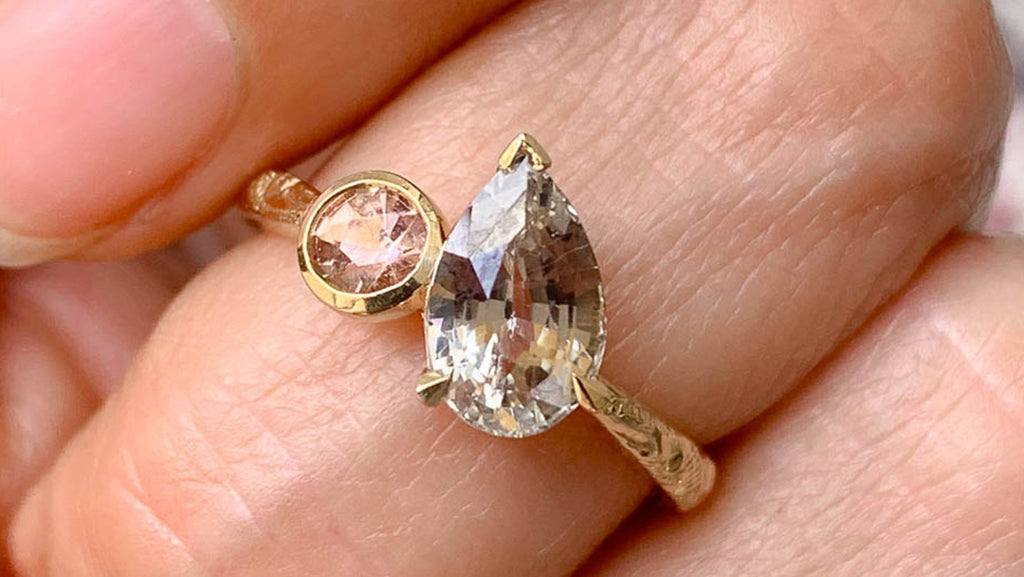
Gauging how these champagne diamonds would work in a toi et moi engagement ring
Champagne diamonds are generally still cheaper than colourless diamonds, for a few interconnected reasons. The diamond standard of ‘perfection’ will always pertain to colourlessness and extreme clarity. No matter how subjectively beautiful, diamonds that grade lower in colour and clarity are comparatively less valuable - and that is ultimately down to rarity. What’s more, a darker tint helps to mask inclusions, which means a champagne diamond could score relatively low on the clarity scale whilst still looking beautiful, nudging its price down further.
From a design perspective, this relative affordability opens up considerable creative freedom. For those working within a budget, a champagne diamond is an opportunity to enjoy the resilience of a diamond whilst welcoming a larger carat weight and additional design features that might have otherwise been unfeasible.
Why couples are turning to coloured stones
The shift away from the colourless diamond solitaire has been gathering momentum for years, and it’s driven by more than just aesthetics.
Affordability
The ‘three months’ salary’ rule was a deliberate marketing construct. De Beers originally promoted its one month's salary guideline in the 1930s, later pushing that to two months in the US, before spending the equivalent of three months’ pay on a high-quality diamond engagement ring became the norm in Japan through more targeted advertising campaigns.
Fast-forward to the 2020s and housing costs have risen dramatically relative to income, student debt is widespread, and the cost of living has squeezed disposable income in ways previous generations did not face. For many couples, spending the equivalent of three months' salary on a single object feels genuinely irresponsible when a deposit on a home – for example - is the more pressing priority. Today, many couples feel no obligation to honour a spending benchmark that was initially designed only to sell more diamonds.
Shifting values around consumerism and display
Younger consumers are increasingly sceptical of conspicuous spending as a love language. The idea that the size or quality of a diamond equates to depth of feeling is losing cultural currency, particularly among people who prioritise experiences, ethics and authenticity over status signalling.
More options for personal expression
The rise of coloured gemstones, lab-grown diamonds and reclaimed vintage stones means couples are no longer choosing between a colourless diamond or nothing.
Welcoming the possibility of variation means welcoming many different forms of personal symbolism: birthstones, colour theory, shades that complement a wardrobe or skin tone. As Taylor & Hart’s founder Nikolay Piriankov put it: “It’s more personal, rather than the ego thing of showing everyone how big your diamond is.” Stars have led the charge – from Lily Collins’ blush pink rose-cut diamond solitaire to Tallulah Willis’ antique ‘honey champagne’ diamond and the 5ct black diamond Matty Healy used to propose to his now fiancée Gabbriette – but the appeal extends well beyond celebrity culture.
Are champagne diamonds durable enough for an engagement ring?
Absolutely. Although internally tinted by the presence of nitrogen, champagne diamonds, like colourless diamonds, score a 10 on the Mohs Scale of Hardness - the highest rating of any natural material. This makes them exceptionally resilient to the daily wear and tear of an engagement ring, designed to be worn every day for a lifetime and passed lovingly down from one generation to the next.
For context, sapphires and rubies - the next most popular engagement ring stones - score a 9, also making them excellent choices for everyday wear. More affordable options such as spinel, topaz and alexandrite score an 8, but these gemstones are coded with a different sense of perceived value by some due to their semi-precious nature. Emeralds, whilst beautiful, score around a 7 on the Mohs Scale of Hardness and are thus more susceptible to scratching, making them less well suited to an everyday ring.
Consider also: champagne sapphires

For those who love the warm, earthy palette of champagne diamonds but are working with a tighter budget - or who simply want the option of a larger centrepiece - champagne sapphires are an alternative worth exploring. Relatively easy to source and considerably more affordable than champagne diamonds, they share a similar tonal quality while offering their own distinct character. Scoring a 9 on the Mohs Scale of Hardness, they are also perfectly suited to everyday wear.
Why we love champagne diamond rings
Precious metals and gemstones are formed over deep time through extraordinary geological and cosmic processes. They are survivors of the immense timescales of the universe’s evolution - reminders of the comparative limitation of human experience. Whether rare and colourless or abundant and brown-tinted, diamonds are the fruit of our planet, and we cherish them for that.
There is something quietly radical about choosing a champagne diamond: it is a rejection of the idea that value is determined by conformity to a grading system, and an embrace of what the earth actually produces. The warm neutrality of a champagne diamond is also surprisingly wearable - complementary of all metal colours and a wide range of skin tones, and carrying the celebratory associations of champagne itself, linked to happy occasions and new chapters since the royal courts of Europe in the early 1700s.
If you would like to explore champagne diamonds for your engagement ring, wedding band or bespoke commission, we would love to help. Browse our collection or get in touch to begin a conversation.a

Written by Arabel Lebrusan