
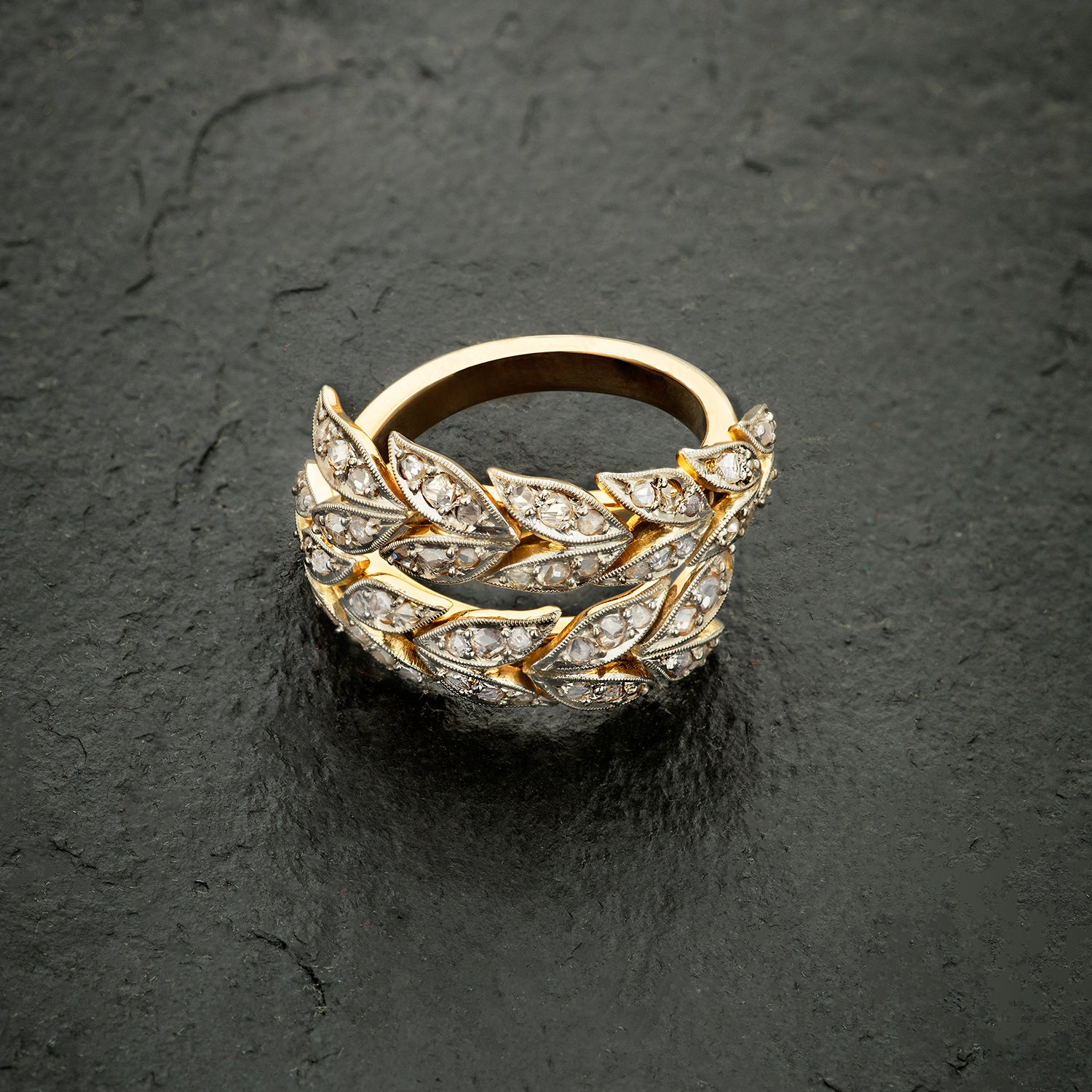

Classic engagement rings with a twist
An engagement ring is a deeply significant piece of jewellery, tasked with the intricate job of speaking without words. Details are paramount and no corners should be cut: But the wheel need not be reinvented for a meaningful engagement ring that makes your partner feel seen.
In fact, classics are classics for a reason. An engagement ring that builds upon the strong foundations of traditional blueprints is one that will age gracefully; eventually passed on as an heirloom to tell stories not of a fleeting moment in time, but a life well-lived.
Drawing on over 20 years of jewellery design experience, this guide explores how a design can embody classic simplicity AND the details that matter deeply to you – because ‘timeless’ is not synonymous with ‘faceless’.
FIRST: WHAT IS THE MOST CLASSIC ENGAGEMENT RING STYLE?

Andy’s bespoke 2.5ct diamond solitaire engagement ring
In 1886, Tiffany & Co. debuted their revolutionary Tiffany® Setting ring. A slim platinum band set with a single white diamond, this was the first design to elevate the stone in a raised claw setting, enhancing its natural radiance by allowing light to enter and leave at every angle. Celebrated in film, art and literature, the Tiffany® Setting quickly became the most sought-after symbol of love: The face of the engagement ring as we know it. Today, the single-stone engagement ring (the ‘solitaire’) remains a favourite amongst loved-up couples, accounting for the majority of engagement ring orders we receive each year.
Though the claw solitaire is firmly cemented as a classic, we’ll never cease to appreciate the ingenuity of its engineering: A setting evolved specifically to celebrate the internal magic of a diamond or gemstone, utilising the simple gift of light to showcase its faceted structure, colour and brilliance.
A CLASSIC WITH A TWIST: SOLITAIRE ENGAGEMENT RINGS WITH HAND-ENGRAVED BANDS
 Our Athena engagement rings
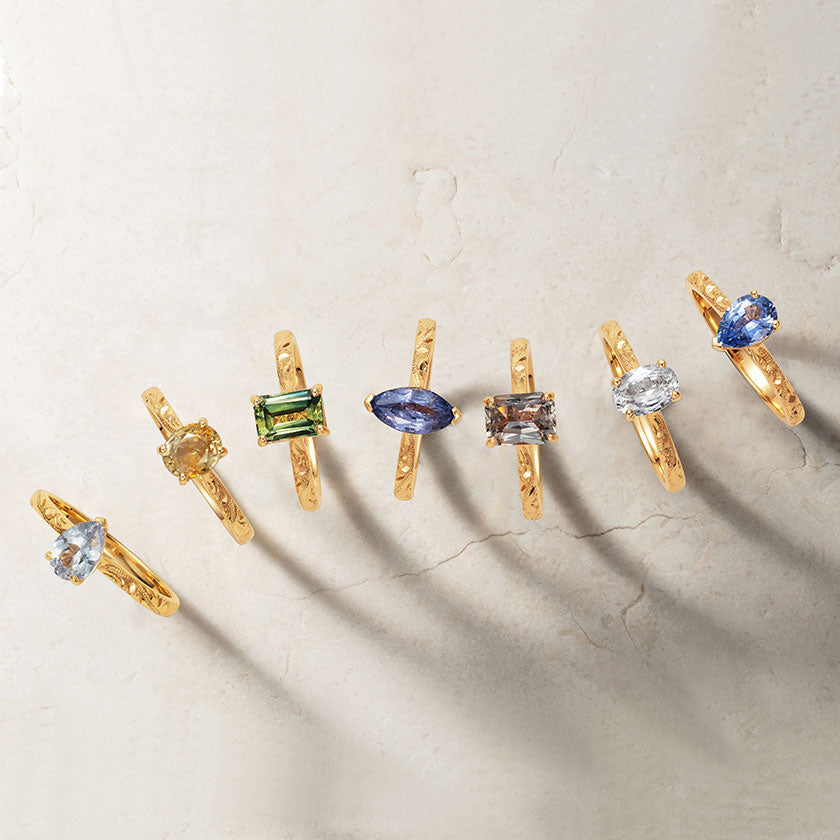
Our iconic Athena Collection takes all the hero qualities of the solitaire design – its slender band, raised prong setting and spot-lit centrepiece – then elevates it with intricate scrolls, hand engraved by our master craftsman Darren.

Our Engraved in My Heart engagement ring
Similarly, our Engraved in My Heart engagement ring further conforms to type with a six-prong setting and tapered shoulders, this very band open to your choice of hand-engraved vines, hearts or eternal loops.
If your imagination leads you beyond this existing stock of engraved motifs, you might even wish to customise your band with a custom pattern.
Simple but effective, these engraved solitaire engagement rings are an opportunity to invest in a timeless heirloom jewel whilst simultaneously enjoying the pleasure of expressive detail and traditional British craftsmanship. You can think of these designs as tiny works of art that will never fall out of fashion.
TWISTED FURTHER: SOLITAIRE ENGAGEMENT RINGS WITH FANCY GEMSTONES
 The average engagement ring spend has decreased considerably in recent years, and that’s partly down to the increasing popularity of coloured gemstones like sapphires and rubies. Though equally as precious and almost as resilient, these cardinal gemstones tend to be cheaper than diamonds of comparable size.
Our Fancy Athena collection reimagines our Athena solitaires by swapping the quintessential colourless diamond for gemstones in a vibrant variety of fancy cuts and shapes. From cushion-cut zircon in a sumptuous champagne hue to a pear-cut salt and pepper diamond and a marquise sapphire in a striking shade of violet, these jewels are an invitation to enjoy the romantic icon of a single-stone engagement ring whilst embracing the joy of colour and form.

Our ready-to-wear Fancy Athena engagement ring with an oval-cut yellow Sri Lankan sapphire and 18ct recycled yellow gold
What’s more, the variety within our Fancy Athena collection is not just a matter of shape and shade, but of story. One fancy gemstone can be traced back to a named mine in northwest Canada, another is a reclaimed vintage stone, and another is of traceable Sri Lankan origin. When engagement ring design is not a narrow pursuit of the largest and most ‘perfect’ diamond attainable, there is real magic to be found; Your timeless engagement ring could serve as a mouthpiece for its own origin story for generations to come.
THE MAGIC NUMBER: TRILOGY ENGAGEMENT RINGS MULTIPLY THE DESIGN POSSIBILITIES

Our Athena Trilogy engagement rings with flanking birthstones
Deriving its name from the Greek tri, meaning ‘three times,’ and logia, meaning ‘story,’ the trilogy engagement ring is characterised by three gemstones set side by side. The most widely regarded symbolism of the trilogy ring is the concept of eternity, its stones representing the past, present and future of a couple's union. Since its heyday in the Victorian era, the trilogy engagement ring's role as a symbol of everlasting love has secured it a firm place at the top of the popularity ranking. Romance never goes out of style.
The most prototypical trilogy design consists of three round diamonds in a graduated formation (meaning the central stone is slightly larger and more elevated than those flanking it), traditionally secured in claw settings. We’ve had plenty of fun reinterpreting those margins over the years.

Our ready-to-wear Fancy Hera trilogy engagement ring
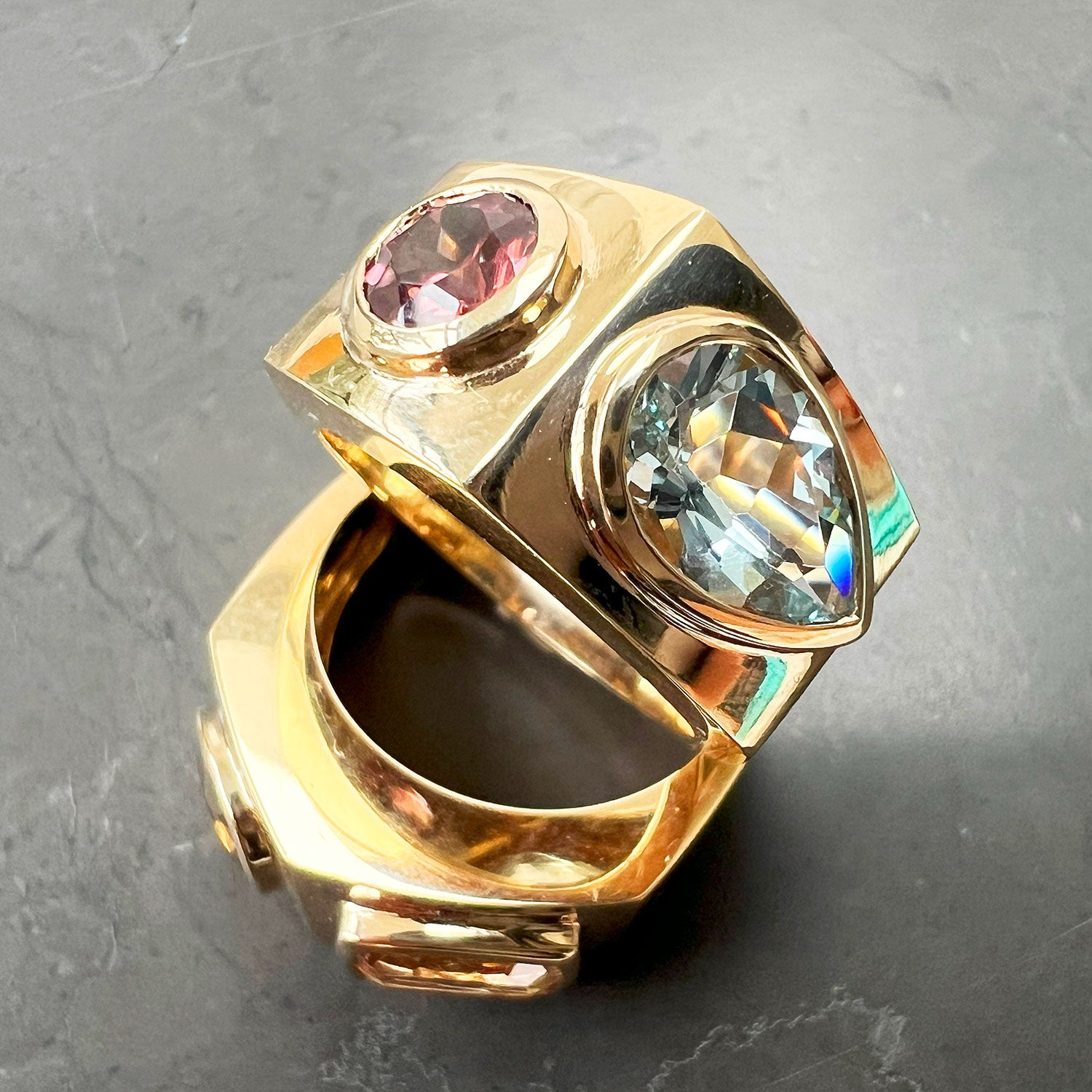
Our Demeter Trilogy rings, for example, swap those claws for bezel settings. Our Fancy Hera trilogy uses just one bezel setting to accommodate all three baguette sapphires in close proximity. We’ve even crafted trilogy engagement rings, like those designed for Mark and Andrew, which combine a central bezel setting with claw-set side stones.

A one-off trilogy design, inspired by the rose Fairmined Ecological Gold band and pear-cut cognac diamonds of Chris’ bespoke engagement ring
If you’re drawn to the symbolic concept of the trilogy but not the design elements of a typical three-stone ring, the format can be reinvented further still. Today, we’re seeing an increasing number of couples embracing engagement rings, wedding bands and commitment rings combined into one all-encompassing jewel, or a meaningful stack of rings that doesn’t confirm to traditional categories but exists simply as a celebration of love.

Our Freedom collection, for example, consists of combinable components. Clients are invited to mix and match rings that vary in colour, texture, shape and width, then have them soldered together into a unique, self-curated stack. With each section representing a particular aspect of life or moment in time, a three-part Freedom ring is a contemporary take on the trilogy.
Personalising your engagement ring with a birthstone

Craig's bespoke trilogy engagement ring, crowned with a 0.53ct old-cut diamond and two marquise-cut garnets to celebrate his partner's January birthday
The durability of precious gemstones is ranked on the Mohs Scale of Hardness. Some are tougher than others, which makes them better equipped to withstand daily wear in engagement rings. Hardy gemstones like April’s diamond or September’s sapphire are the most popular choices, but there are techniques that allow softer birthstones to be incorporated into engagement ring designs, too.
The only birthstone without the resilience to stand up to everyday wear is the pearl, which scores only 2.5 on the Mohs Scale and is incredibly easy to scratch or abrade. For anyone born in June, moonstone and alexandrite are tougher alternatives.
Here’s how each birth month's stone compares for hardness…
- January: Garnet (6.5 to 7.5)
- February: Amethyst (7)
- March: Aquamarine (7.5 to 8)
- April: Diamond (10)
- May: Emerald (7.5 to 8)
- June: Pearl (2.5), moonstone (6 to 6.5) or alexandrite (8.5)
- July: Ruby (9)
- August: Peridot (6.5 to 7) or spinel (8)
- September: Sapphire (9)
- October: Opal (5 to 6.5) or tourmaline (7 to 7.5)
- November: Topaz (8) or citrine (7)
- December: Turquoise (5.5), Tanzanite (6 to 6.5) or zircon (7.5)
Whilst the claw setting is best suited to gemstones that rank 8 or above on the Hardness Scale – resilient enough to withstand the vulnerability of being elevated and exposed – enclosed bezel settings offer greater protection to softer birthstones like emerald or tourmaline.
Another considered method for incorporating soft birthstones safely into an engagement ring is to use them as side stones in a trilogy design. Alternatively, you may wish to incorporate your partner’s birthstone into a striking halo, encircling a tough centrepiece with tiny colour accents. The smaller the birthstone, the lower the risk of significant damage.

Laura's bespoke engagement ring, set with a 0.8ct Sri Lankan sapphire centrepiece, encircled by a halo of amethyst, the birthstone for February
Meanwhile, a ‘secret setting’ does exactly as it says on the tin, securing a gemstone into the inside of a ring's band, tucked quietly away for only chosen eyes to see. Whether your partner's birthstone is soft or hard, this subtle twist is an opportunity to add personal symbolism to your partner’s engagement ring without compromising the classic simplicity they may be after.
Nature inspired engagement rings

A universal form of adornment, jewellery is as almost old as the human race itself. Jewellery made from shells, stones and bone survives from prehistoric times - millions of years later, the natural world continues to serve as both toolbox and inspiration.
Floral engagement rings date back as early as the 18th century, when silver posy rings engraved with small flowers were considered the height of fashion in Europe. Following the wedding, these silver bands were often replaced with an identical design in yellow gold, sometimes inscribed with a love poem or a Shakespeare reference.
The 19th century brought technically accurate fruit, flora and foliage motifs, thanks to a widespread interest in botany and the influence of Romantic poets such as Wordsworth. By the 1850s these delicate early designs had given way to more extravagant, complex compositions, nature's hues matched by coloured gemstones and a language of flowers spelling out messages of romance.
Our nature-inspired engagement rings showcase a rich tapestry of aesthetic, historic and cultural inspiration, honouring classic romantic symbolism with contemporary materials that have a story to tell. Each one begins with the familiar foundations of a traditional engagement ring - a slender band and a round centre stone - then adds a botanical twist in the form of engraved leaves, petals or blossoms. The result is a silhouette you recognise, carrying something unmistakably your own, much as those early posy rings did centuries ago.
Final words of advice: Loosen your grip on fleeting engagement ring trends
 Custom Artisan Trilogy engagement ring with a 1.01ct oval-cut Ocean Diamond and pear-cut African conflict-free side diamonds
Engagement ring trends are worth noticing - often capturing the cultural zeitgeist and offering an interesting source of inspiration – but they should never take the final word. If nothing currently fashionable aligns with yours or your partner’s vision, that is no reason for concern. This engagement ring is yours to enjoy forever, and only you can decide what feels right.
Think carefully about your partner's personal style and try to honour it in some way. Do they tend to be drawn to a particular colour? Is there a historic design movement that interests them? Do they prefer to make their statements quietly, or do they speak their truth at volume? Preferences evolve over time, but an engagement ring chosen thoughtfully will not date the way a passing trend might. Tapping into an aesthetic or sentiment that matters to your partner on a personal level will nurture a deeper sense of connection with their special piece of jewellery.
Antique- and vintage-inspired elements tend to share this staying power. Bezel settings, milgrain, hand engravings and old-cut diamonds are all time-honoured design features that enjoyed their advent generations ago and remain firmly in favour today. There’s something timelessly romantic about details and techniques that never lost their charm.
This guide touches on just a few of the ways a classic engagement ring can be enhanced or personalised, but if you wish to further explore the scope of our design and craft capabilities, you might benefit from a bespoke consultation.
Here at Lebrusan Studio, every bespoke commission begins with a conversation and a sketchbook. From there it's a journey through drawing, material study, stone selection, and the hands of craftspeople we've worked with for years, until something exists that's entirely your own and could have come from nowhere else: A classic with your own personal trademark.
If you have enjoyed this article and would like to learn more about ethical jewellery, make sure you sign up below to receive our newsletter and tell a friend about our services. Don’t forget to give us a call or drop us an email if you need further advice.
Follow us on Instagram and Facebook for daily behind the scenes updates.
Love, Arabel & Team