
Article: A Coat of Arms in Low Relief: The Making of a Custom Medallion
A Coat of Arms in Low Relief: The Making of a Custom Medallion

Every so often, a bespoke commission arrives at Lebrusan Studio that asks us to reach past the language of celebration and into a realm that more closely resembles contemporary art. J’s bespoke medallion was one of those.
J is a client we have worked with for over a decade: An art collector and an appreciator of jewellery who has entrusted our Founder Arabel Lebrusan with increasingly adventurous ideas over the length of their creative synergy to date. This piece, a medallion necklace bearing a coat of arms designed for him alone, is the most ambitious of them yet.
A Custom Crest Designed for J

J is not only a client of our Founder Arabel Lebrusan, but also of the Guyanese-British sculptor and contemporary visual artist Hew Locke, whose work examines colonial and post-colonial power and the way different cultures fashion their identities through visual symbols of authority.
Drawing together a set of personal and symbolic references, it was in fact Locke who created the coat of arms at the heart of this piece of jewellery. J then brought Locke's drawing to us, and from that point, the designing process became a close and continuous conversation between J and Arabel.
Locke’s references reward slow and careful inspection. There are diatoms, the microscopic single-celled algae found in oceans, waterways and soils across the world: A reminder of the abundance of life carried in even the things too small for the human eye to see. There is Beaudouin's snake eagle, a bird native to West Africa. There are the shielding wings of Isis, the Egyptian goddess of magic, motherhood, healing and protection. And, central to all, there’s a portrait inspired by the form of Nok sculptures, the ancient terracotta works made by the Nok culture that flourished in central Nigeria between roughly 500 BCE and 200 CE. The earliest known large-scale sculptures in Sub Saharan Africa, Nok sculptures are recognisable for their stylised heads with pierced triangular eyes, arched brows and elaborately detailed hair and jewellery.
The Low Relief Technique

Though Locke’s drawing could easily have been realised as an engraving in the medallion’s flat surface, Arabel opted to interpret the intricate design using the low relief method.
Low relief is a sculptural technique in which the design rises only slightly from a flat background, relying on subtle contour, three-dimensional ‘shading’ and a deep understanding of perspective. Because of its shallow rise and gradual slopes, it’s the technique traditionally favoured for medals and coins, belonging to the wider practice of art medal-making: A discipline with a lengthy and serious history of its own.
Medals have always represented much more than occasion. Across centuries they’ve served as vessels for allegiance, protest, memory and identity; small objects made to be held, worn and handed on. Choosing the low-relief technique was, in that sense, a choice about the kind of object J’s medallion would be.

The process began with very little: A lump of plasticine, a set of engraving tools and tracing paper that would enable Arabel to accurately map Locke’s pencil drawing onto the plasticine’s surface. Arabel gradually modelled the coat of arms by hand, carefully carving and building up the relief over many hours until Locke's drawing had become a three-dimensional surface.
The finished model was scanned to create a Computer Aided Design (CAD) file, which allowed the design to be scaled up or down with precision and invited the possibility of adding a laser inscription to the reverse of the medal.

The medallion’s hand-modelled origin honours a very old way of working. Meeting that approach with contemporary CAD tools further enabled Arabel to realise the design faithfully. Arabel has described the pleasure of taking the most enjoyable parts of each: The tactility of modelling by hand and the control of handling that model on-screen. The result is a piece of jewellery with a foot in each world, ancient in its craft and contemporary in its precision.
The Art of Medal-Making, Rediscovered

For Arabel, this bespoke commission reopened a door that had been closed for a long time. She first learned medal-making during her twenties, studying for a Fine Arts degree in her native Madrid. She was taught by Francisco López Hernández, the great master of contemporary medal-making who dedicated a large proportion of his career to teaching and developing portraiture as the foundational element of traditional medal art.
It was in 2023, when Arabel created Joias – a coin depicting Eliane Mello and her 6-month-old unborn child who died at the Brumandinho iron mine disaster in Brazil in 2019 – that she returned to medal-making and remembered her appreciation for the low relief process.

Since further reigniting the spark through the medium of J’s medallion, Arabel has connected with the British Art Medal Society, securing future mentorship.
Laser-Inscribed Words

The reverse of the medallion carries the laser inscription that CAD made possible. J chose a proverb of the Berom people of Plateau State in north central Nigeria, which translates as "When the old songs are forgotten, the children dance to silence." It’s a reflection on oral history: About the quiet cost of letting stories go untold. When we stop passing knowledge and sentiments down, it warns, they become lost.
Whilst J’s crest is built from the visual icons, the proverb is its spoken argument. Together they make this object a statement about memory, inheritance and about the responsibility of carrying a heritage forwards.
Brought to Life in 18ct Gold and Fair-Traded Gemstones

Once the CAD file was finalised, the medallion was cast in 18ct white gold. Through ongoing dialogue, J remained closely involved in the making of the pendant, liaising with Arabel to settle on its organic textured finish.
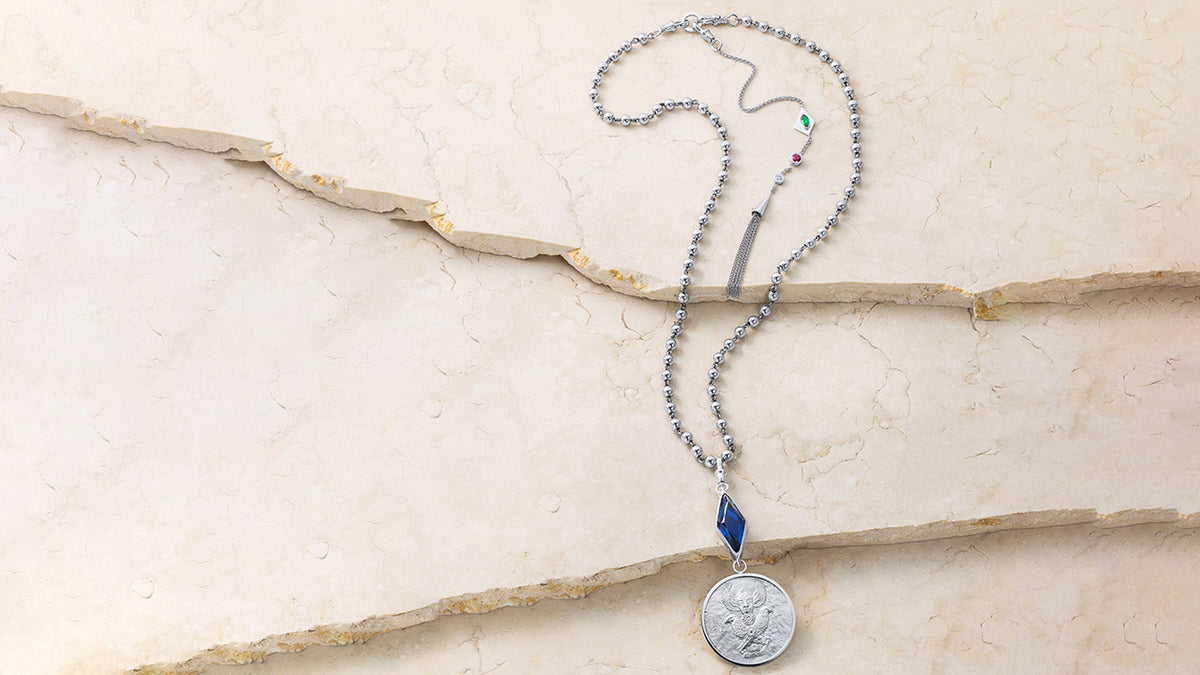
Following casting, the medallion was hung from a chain handcrafted from 18ct white gold beads and darkened platinum wire. A vibrant colour accent is delivered courtesy of a 12.67ct kite-cut blue sapphire from Malawi’s Chimwadzulu Mine, one of Africa’s oldest and most prominent sources of high-quality rubies and sapphires. A second back-drop pendant hangs complete with tassels and articulated charms set with ruby, emerald and diamond respectively. As a whole, the necklace is more than a single fixed image but an assembly of meanings.

Viewed as a whole, J’s medallion is a study in how meaning accumulates in layers. Hew Locke’s coat of arms supplies a vocabulary of symbols; the Berom proverb turns that imagery towards a reflection on memory and inheritance; and the sapphire from Malawi’s Chimwadzulu Mine speaks of origin, tracing the piece back to the African landscapes from which its materials came.
Whilst the hand-modelled low relief places this jewel firmly within the tradition of medal making, the choice to embrace contemporary tools such as CAD and laser inscription allowed Arabel to layer old and new techniques, carrying that tradition forwards.
J’s medallion stands as both a personal heirloom and a small work of contemporary art: An object that will go on gathering meaning each time it's worn and, one day, handed on.
Lebrusan Studio is an artist-led design studio that creates jewellery for people who care. Jewellery that embodies considered, enduring design, exquisite local craftsmanship and carefully sourced materials, purposeful in its mission to make the world a better place. A Lebrusan Studio bespoke commission is an heirloom that tells stories you can feel proud to pass from one generation to the next; a wearable vessel for social, political, environ mental and economic change.
Behind Lebrusan Studio’s ornate jewels is our founder: award-winning jewellery designer and visual artist, Arabel Lebrusan. As well as a trained gemmologist, Arabel holds a Masters Degree in Sculpture from the Royal College of Art, a second Masters Degree in Jewellery Design from London’s Central Saint Martins and a Bachelors Degree in Fine Art from the University of Madrid. With two decades of designing experience and a list of accolades under her belt, Arabel is a multifaceted artist who specialises in creating timeless heirloom jewels to be cherished by generations to come. To book your bespoke consultation, please get in touch today.

Written by Arabel Lebrusan