

What are jewellery hallmarks? UK, US and Europe explained
"Often in the world of jewellery collecting, there is confusion about what a hallmark is, and how it differs from a purity mark or a maker's mark."
It's very rare that a piece of jewellery is cast using 100% precious metal. Most jewellers combine - or 'alloy' - precious metals with other metals in order to increase durability, make the metal easier to work with or make the finished jewel more wearable.
Many people are surprised to learn, for example, that platinum in its pure state is soft and unsuitable for creating jewellery. That's why the most common type of platinum jewel is 95% pure platinum and 5% other metals that add critical technical properties - thus hallmarked '950'. Rhodium, for example, raises melting point and increases hardness, and often makes the platinum alloy appear brighter and whiter.
In many countries, it's a legal requirement to brand jewellery with a mark that verifies the percentage of precious metal present. This is called hallmarking, and whilst it's standard practice here in the UK, it's not actually mandatory everywhere in the world. So what are the key differences between British hallmarks and those you might encounter in the US or across Europe?
Hallmarks in the UK

The UK holds some of the strictest hallmarking laws in the world. Every piece of jewellery made from precious metal and sold in the UK must be sent to one of four Assay Offices, where government employees test each piece for its precious metal percentage and stamp them with the relevant hallmarks.
Historically, hallmarks in the UK were made by punching the mark into the metal with force. Today, it's more common that lasers are used to etch the mark into the piece. The mark made depends on which of the four Assay Offices the piece was sent to, but the presence of the mark itself verifies that the piece was proven to contain the volume of precious metal that the jeweller advertised.
The possible Assay Office marks are an anchor for Birmingham, a castle for Edinburgh, a rose for Sheffield, and a leopard's head for London. The leopard's head is proudly displayed on most Lebrusan Studio jewels as an indication of their Hatton Garden provenance.
In addition to this legally required hallmark, jewellery must bear a purity mark (which consists of a two or three digit number indicating metal fineness) and a maker's mark — which could be nearly anything, but is often initials or a logo. Our maker's mark is 'AL' for Arabel Lebrusan. Additionally, if a piece of jewellery was created in Britain before 1999, it will bear a date stamp, a legal requirement of all British jewellery until that year.
If a piece of jewellery is created from a special third party-certified metal like Fairtrade Gold or Fairmined Gold, it will also bear a unique stamp that proudly verifies its provenance.
Hallmarks in the US
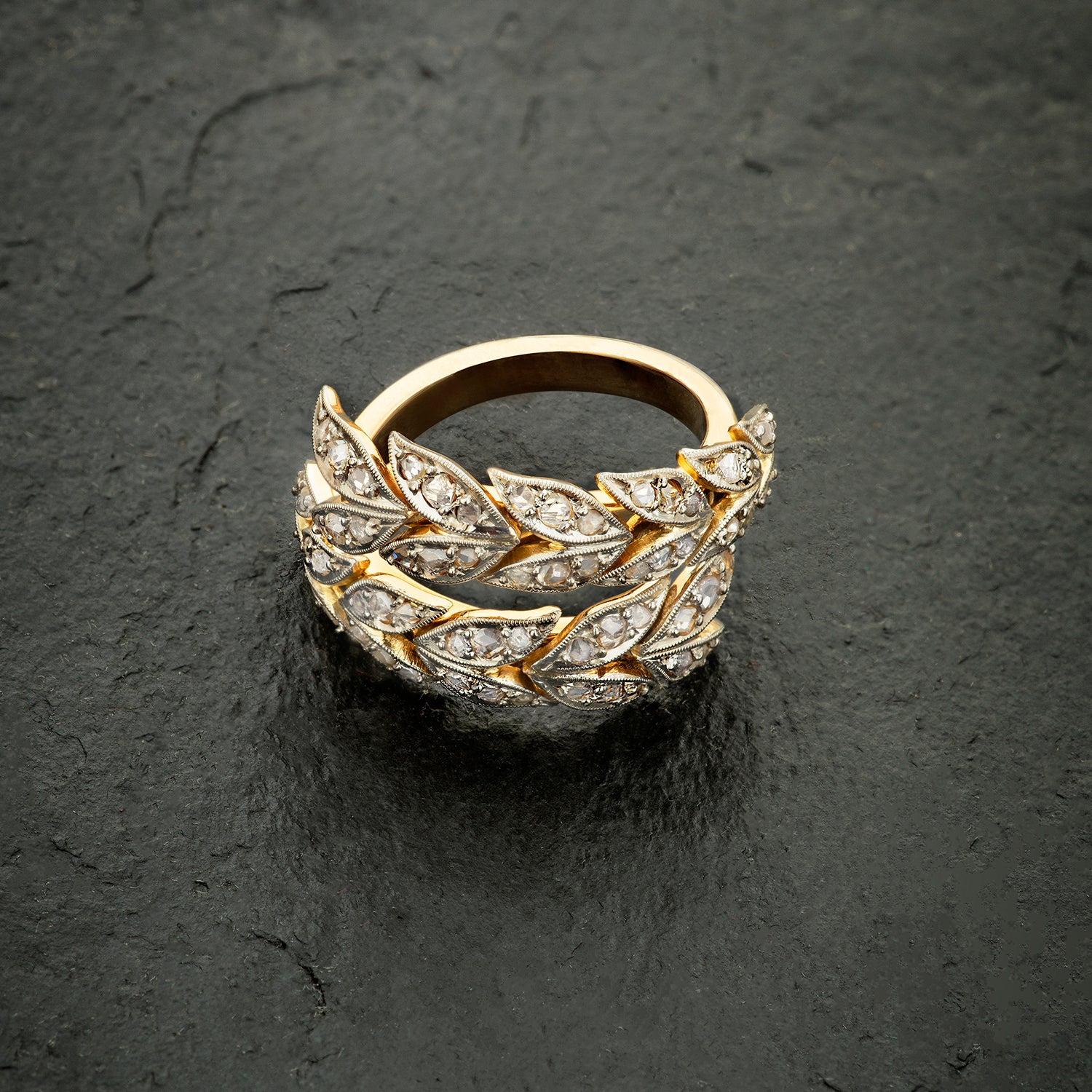
 Tara's bespoke engagement ring, created in the UK using inherited gold and diamonds
In the US, hallmarking is not a legal requirement. Many US jewellery collectors instead look for certain maker's marks for assurance that a piece is of high quality. The problem is that maker's marks aren't regulated, so there's no way to connect a maker's mark to a process that proves a piece is advertised honestly. In fact, in the US, there is no legal requirement to even register a maker's mark; it's simply up to the maker to add their mark as they wish.
Some US companies with large markets in the UK do send their jewellery to UK Assay Offices for hallmarking so they can legally sell their pieces overseas. For US customers seeking assurance that a piece is advertised honestly, shopping with a company that follows this practice could be a safer bet than shopping elsewhere.
As far as collectors of high quality jewellery are concerned, these differences are what make the jewellery market in the UK a different ball game to that of the US.
Hallmarks in France
Like that of the UK, French hallmarking - known as poinçonnage - is a highly regulated system wherein any gold, silver or platinum jewellery must be branded with a maker's mark, a purity mark and a regional assay office mark. Whilst Paris' assay office uses a variety of marks, including the Eiffel Tower, a profile of the Greek Goddess Minerva's head, and the letters 'A' or 'V' - Lyon employs the initials 'L' and 'Y' combined with stars and geometric shapes, and Strasbourg uses the letters 'S' and 'T' alongside floral designs.
Any jewellery created in a precious metal and sold in France must also bear a diamond-shaped mark with four equal sides, called a lozenge.
Hallmarks and maker's marks in other European nations
Hallmarking laws vary across the remainder of the European continent. Some countries, including Hungary, Sweden, Finland and Russia, legally require the hallmarking of any silver, platinum or gold piece of jewellery. Elsewhere, like Italy, purity hallmarks are not required but maker's marks must be registered, and those in themselves are independently recognised as a monitored mark of quality.
The difference between a hallmark and a maker's mark - even in a nation where maker's marks are regulated - is that a hallmark indicates that the piece was physically sent to a third-party office and tested for purity. All European countries do require maker's marks to be registered, however. This honour system requires each jeweller, by law, to test their own pieces and advertise them honestly.
What to look for when buying
Wherever you are buying from, the presence of a UK hallmark is your strongest guarantee that a piece contains the precious metal it claims to. If you are shopping with a US retailer and quality matters to you, it is always worth asking whether their pieces carry a recognised hallmark from a UK or European Assay Office. If they don't, you are largely taking the seller's word for it - and as we have seen, not every market requires that word to be verified.
At Lebrusan Studio, every piece we make is hallmarked at the London Assay Office with a legal mark of metal purity, the London leopard's head, our maker's mark AL, and - where applicable - the Fairtrade or Fairmined provenance stamp. It is not something we do because we have to. It is something we do because you deserve to know exactly what you are wearing.
If you are considering buying jewellery from Lebrusan Studio and would like to understand more about the materials we use, you might find these useful:
Or if you are ready to explore our collections, you can browse our ethical engagement rings and ethical wedding rings — every piece hallmarked in London and made to last a lifetime.