
Is platinum more expensive than white gold?
Precious metals have long been ranked by cultural hierarchy. For millennia, the king at the top of the castle - reigning over silver and gold - has been platinum, recognised globally as the highest symbol of quality and value. Historically, this hierarchy has always translated into material value.
In recent years, however, something unexpected has happened: gold has overtaken platinum in price, and the dynamics between these two metals have shifted considerably. Below, we explore what makes platinum so special, where it comes from, how it performs in comparison to white gold, and what its current price position means for you.
What is platinum?
 Darja's bespoke bombe ring: 5.35ct cushion-cut natural blue sapphire and 2.17ct of conflict-free diamonds in recycled platinum
Platinum is a precious white metal known for its rarity and resilience. 'Discovered' in Colombia in the 18th century by Spanish colonist Antonio de Ulloa, platinum takes its name from the Spanish word 'platina,' meaning little silver.
One of platinum's most distinctive characteristics is its exceptional density and weight. It is 60% denser than gold, making even a small platinum wedding band feel significantly heavier than a gold ring of the same shape and size. Its high melting point - around 1,768°C - and remarkable resistance to corrosion and tarnishing make it highly desirable across a range of industries.
Platinum is a member of the platinum-group metals (PGMs), a cluster of six noble metallic elements in the periodic table: ruthenium, rhodium, palladium, osmium, iridium, and platinum. These transition metals share similar physical and chemical properties and tend to occur together in the same mineral deposits.
Where does platinum come from?

Platinum's origins are cosmic. Its journey begins in the skies through a process called stellar nucleosynthesis. In the cores of large stars, nuclear fusion reactions convert lighter elements like hydrogen and helium into heavier elements such as iron, platinum and gold. When these huge stars exhaust their nuclear fuel, they undergo a supernova explosion or collide and merge with one another. These cataclysmic events generate intense energy, enabling a process known as the rapid neutron capture process (or 'r-process'), wherein free neutrons are quickly captured by nuclei, which become heavier and transform into new elements - including platinum. In other words, the r-process is like a cosmic assembly line, building some of the heaviest elements we know in the universe's most extreme environment.
Once formed in the cosmos, platinum is dispersed into space. When the solar system formed around 4.6 billion years ago, dust and gas coalesced to form the Sun and its surrounding planets, with platinum integrated into the solid material that formed Earth. Today, platinum is found in specific geological environments, typically in association with other PGMs and in ore deposits with nickel and copper. The most significant sources are large igneous provinces - areas formed by volcanic activity. 80% of the world's platinum production currently comes from South Africa and the Sudbury Basin of Canada, with smaller reserves also found in the USA, Zimbabwe and Australia. Each year, roughly 25% of platinum supply is obtained through recycling.
What makes platinum more expensive than gold?
 Damir's bespoke engagement ring
Over gold, platinum has earned its rank for a number of reasons. For starters, gold is far more abundant in the earth’s crust, making platinum rarer. Whilst 1,500 tons of gold are mined annually, only 160 tons of platinum are extracted. When people ask 'Why is platinum not as popular as gold?,' it's less a question of popularity and more a matter of rarity.
Platinum is also denser than gold, thus heavier. Because precious metals are priced by weight, platinum has long been the high-cost option in the context of buying jewellery. But why pay the price for a platinum ring when you could opt for exactly the same setting in white gold for half the cost?
Well, that’s because platinum is also more durable than gold. Its density contributes to its respectable ranking of 4 - 4.5 on the Mohs Scale of Hardness, trumping gold and its hardness of around 2.5 - 3. This toughness makes platinum the perfect choice for day-to-day attire, as it requires less maintenance than other metals and can withstand the most wear and tear.
If it’s a toss-up between platinum and white gold, who share a similar aesthetic, then platinum wins on the hypoallergenic front, too. In order to achieve white gold’s silvery hue, yellow gold must be alloyed with white metal(s) such as silver, nickel, manganese and/or palladium. Nickel in particular is an allergen for many people, earning white gold its itchy reputation. Whilst there’s no such thing as ‘pure white gold’, platinum is naturally grey-white in colour and can only be sold as platinum if 90-95% pure. This not only makes it hypoallergenic, but also means a no-fade guarantee is intrinsic in every piece of platinum jewellery.
As of today, what's more valuable; platinum or gold?
 The platinum foundations of Anna's bespoke engagement ring, eventually set with a nimbus of square-cut orange sapphires
Given its perceived superior properties, the average cost of platinum has historically been higher than that of gold. It makes sense: it is rarer, weightier and harder. But in recent years, platinum has been overtaken by gold in the pricing stakes.
Gold prices have reached record highs, driven by factors far too multifaceted to fully unpack here. In the context of white gold specifically, palladium is partially responsible. White gold is created by alloying roughly 75% yellow gold with 25% other elements - a large proportion of which is palladium. Now one of the most valuable of the four major precious metals, palladium is the chemical element responsible for white gold's silvery hue. It is a by-product of platinum and nickel mining, meaning its output is often slow. Over recent years, its supply has not responded to growing demand, causing a surge in price - driven in part by governments, especially China's, tightening vehicle pollution regulations and forcing car manufacturers to increase the precious metal content of catalytic converters.
The knock-on effect has been a spike in the cost of white gold - so much so that gold has overtaken platinum in price for the first time.
Platinum and recycling: Why it's a little trickier than gold

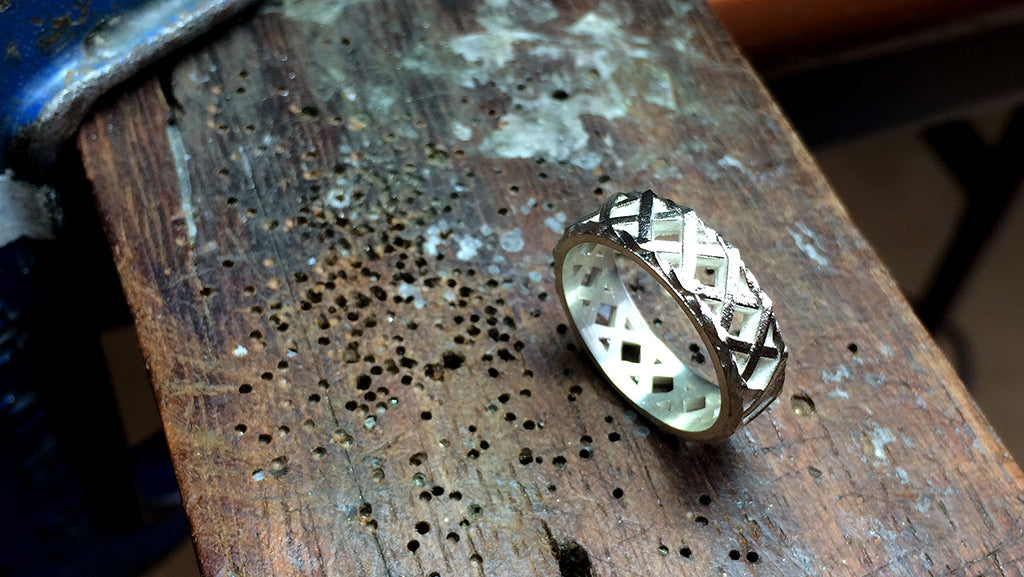
Our Scrolls Engraved wedding bands in yellow gold and platinum
At Lebrusan Studio, we are advocates for the circularity model: minimising waste, pollution and consumption of natural resources by regenerating materials already in circulation. Jewellery deals in naturally resistant materials whose toughness lends itself readily to repeated recycling or refurbishment with little degradation in quality. Offering recycled gold and platinum across our collections is, from our perspective, a no-brainer.
Repurposing old jewellery is not only beneficial from an environmental standpoint; it also enables us to celebrate legacy and pass memories and sentiments from one generation to the next. We are often asked to recycle clients' platinum and gold heirlooms into brand new pieces. As with any worthwhile endeavour, recycling precious metal is not without its challenges, particularly when it comes to platinum. Here's why platinum is generally a little trickier to recycle than gold...
Gold is more abundant than platinum
Gold is significantly more abundant than platinum in the earth's crust - there is thought to be around 33% more gold down there than platinum. From a jeweller's perspective, this abundance makes recycling gold a little cheaper than recycling platinum.
For clients keen to incorporate the metal of their existing jewellery directly into a new commission for sentimental reasons, we have it melted down. What many do not know is that melted platinum and gold do not tend to go very far - so unless the original jewellery yields a significant volume of metal, it is necessary to bulk out the alloy with additional material. At this stage, it is easier and cheaper to introduce further gold than platinum.
Gold has a lower melting point than platinum
Both gold and platinum belong to the periodic table's transition metal group. However, despite sharing similar crystal structures, platinum has a stronger metallic bonding than gold, resulting in stronger forces between atoms and requiring higher temperatures to transition from solid to liquid. Platinum melts at 1,768°C; gold melts at around 1,064°C - making gold considerably easier to break down and process.
Gold is more chemically stable than platinum
Gold is highly resistant to corrosion and oxidation, making it easy to recover and recycle. Platinum, although relatively stable, is more reactive with certain chemicals than gold and can be more challenging to handle during the recycling process.
Platinum has very specific industrial applications
The range of industrial applications for gold is diverse, spanning electronics, dentistry and aerospace. Platinum, meanwhile, plays a crucial role in more specific applications - particularly petroleum refining and catalytic converters, the car parts used to convert harmful emissions into less harmful substances. These converters contain a combination of platinum, palladium and rhodium, and separating these metals requires highly specialised techniques.
Recycled platinum: a juice that's worth the squeeze
Although gold is somewhat easier to recycle to 100% purity, that does not mean your old platinum is off-limits. From an environmental perspective, recycling metal in any capacity - whether reintroducing it to the pool as scrap or repurposing it directly as a new piece of jewellery - is significantly more resourceful than sourcing newly mined metal. We can successfully recycle platinum to 100% recycled purity, with our recycled platinum never containing less than 90% pure recycled platinum.
Now's your chance
 The
The Platinum prices could remain low, or this moment in time could be anomalous. Either way, this sturdy and attractive white metal is currently more affordable than it’s ever been.
Honesty and transparency are at the very core of Lebrusan Studio’s ethos. That’s why we’re sharing these insights with you today and why we regularly re-evaluate the prices of all of our jewellery, adjusting in accordance with the ever-shifting precious metal climate. As such, our platinum pieces are no longer more expensive than our white gold jewels.
 Ev's bespoke Zodiac pendant, crafted in recycled platinum
All of our platinum jewels are cast in recycled platinum from a fully certified and single-recycled source. This means that when you buy a beautiful and long-lasting platinum piece from Lebrusan Studio, you’re not contributing to the use and abuse of our natural resources inherent in mining new metal from the ground.
And if you’re keen to know more about where the recycled metal in your jewellery comes from? Feel free to drop us an email; we’re always happy to help.
Check out our collections of platinum engagement rings and wedding bands or get in touch today to discuss an utterly unique bespoke platinum creation.