
9ct, 14ct or 18ct Gold: What's the difference and does it matter?
If you're wondering what exactly is meant by 'carat,' what the fundamental differences are between 9ct, 14ct and 18ct gold, and whether one is more suitable than the other for your engagement ring, wedding band or bespoke commission, you're in luck. This blog post answers all of those questions.
Pure gold is very soft and often not practical to use alone in fine jewellery. For this reason, it's combined with other metals for durability. This hardiness is particularly important in the instance of gold engagement rings and wedding bands, which are exposed to the elements every single day in a quest to withstand the tests of time. Caratage is the measurement of gold's purity; it indicates the volume of pure gold in an alloy.
Does gold carat weight affect its colour?
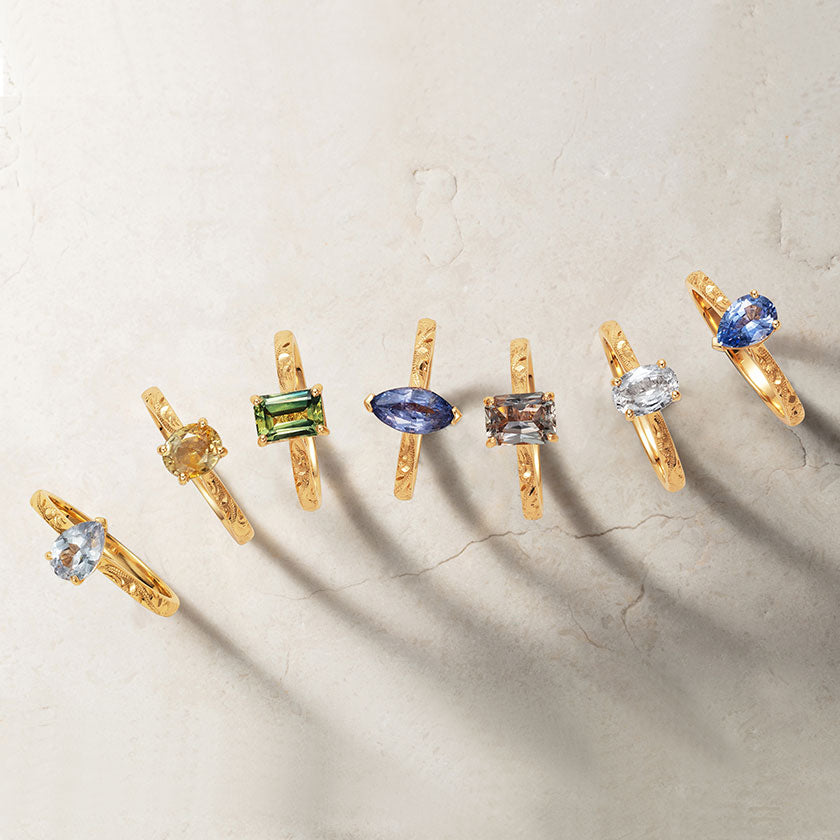
 Our Athena solitaire engagement ring paired with our scroll-engraved Wishbone wedding band, alongside our Daisy cluster engagement ring paired with our Amare Marquise wedding band
Carat weight is in fact the only factor to influence the appearance of gold. Whilst provenance makes no difference (Fairtrade, Fairmined, recycled or industry standard - 18ct gold looks like 18ct gold), the lower the gold content the more diluted the metal in hue. You'll notice that 9ct gold is lighter, less yellow and less lustrous than its 18ct counterpart.
What is 9ct gold?
9ct gold has a content of 37.5% pure gold and 62.5% other metals. In short, 9ct gold is only 9 parts pure gold out of 24.
Whilst 9ct gold is technically harder than 18ct gold, scoring higher on the Mohs Scale of Hardness, this doesn't mean it's more resilient in the long-term. 9ct gold is in fact more brittle, which means it's less resistant to knocks and scratches on a microscopic scale. When compared over a longer period of time, 18ct gold has got what it takes to hold its own. All in all, 9ct gold is tough enough to survive a lifetime of wear, but 18ct gold is better suited to heirloom pieces chosen with future generations in mind.
At Lebrusan Studio, we don't work with 9ct gold. The reason is straightforward: we do a great deal of hand engraving, and 9ct gold is simply too soft to hold the detail of our master engraver Darren's work over time. The intricate patterns he etches into our wedding bands and engagement rings demand 18ct gold - it is the only caratage that will preserve them as they were intended, for a lifetime and beyond.
What is 14ct gold?
14ct gold has a pure gold content of 58.5%. In other words, 18ct gold is 18 parts pure, whilst 14ct gold is 14 parts pure.
In simple terms, the higher the pure gold content, the more saturated the hue. That said, it's only when an 18ct gold jewel is placed side by side with a 14ct gold jewel that the difference in colour is truly noticeable, with 14ct gold only marginally less vivid than its purer counterpart. 14ct gold jewellery is lustrous, beautiful and undeniably gold, its lower pure gold content doing little to impact the overall aesthetic.
Both 14ct and 18ct gold alloys are highly resistant to tarnishing and corrosion, due to the inertly resilient nature of gold. However, the greater presence of alloy metals in 14ct gold, particularly copper, can pose a slightly higher risk of tarnishing than 18ct gold, whose higher purity content lends it a lower level of reactivity to external elements.
The greater the gold content, the higher the price per gram. Generally speaking, 14ct gold costs around two thirds less than 18ct gold. For those shopping on a tighter budget, this makes it a clever compromise between value and durability. Scaling back the overall cost in this way may allow more room in your budget for bespoke design features or a larger gemstone, which can in turn add to the intrinsic value of a finished jewel.
However, 14ct gold is far less common in the UK than in the US. Although the growth of international markets is slowly driving the popularity of 14ct gold in the UK, it remains much scarcer in local markets than its 9ct or 18ct counterparts. At Lebrusan Studio, we offer 14ct gold as an option on our mens wedding rings, where it serves as a more affordable alternative for those seeking a durable everyday band without the premium of 18ct.
 His and hers - two flat-profile wedding bands in 18ct yellow Fairtrade Gold, hand engraved with private messages inside
What is 18ct gold?
18ct gold is 75% pure gold and 25% other metals, that mix of extras dependent on the type of gold in question. Rose gold contains a heavy copper content, whilst the 25% remainder of white gold usually consists of white metals like palladium and zinc, which contribute to the silvery hue.
18ct gold is our primary offering across all engagement rings, wedding bands and bespoke commissions. It is the gold we recommend for heirloom pieces chosen with future generations in mind, and the only caratage we use for hand-engraved designs. Its slight softness relative to lower carat alloys is in fact an advantage from a craft perspective, allowing our engravers to work with greater precision and produce finer, more enduring detail.
Purer gold alloys like 18ct have also historically retained higher market value over time than lower purity alloys, which tend to be favoured less highly by investors. If you're seeking jewellery as a long-term financial investment, this is worth bearing in mind.
Which should you choose?
 Our D-shaped Diamond Star wedding band stacked with our D-shaped Beloved Diamond wedding band
If you're commissioning an engagement ring, wedding ring or bespoke piece with us, 18ct gold is almost certainly the right choice. It is what we work with, what our craft demands, and what we believe makes the most beautiful and enduring heirloom jewel. If you're dreaming of an intricately hand-engraved design like our Athena Grande engagement ring or our Cedar wedding band there's no question about it: 18ct gold is the option for you.
If you are looking for a more affordable mens wedding band and engraving is not a priority, 14ct gold is a sensible and handsome option that we are happy to work with. If you're open to something rustic and weathered like our matte hammered bands, whose surfaces cleverly absorb day-to-day knocks and scrapes, our 14ct alloy works perfectly with them.
As for 9ct gold, it has its place in the wider jewellery market, but it is not something we offer. Our commitment to hand engraving and heirloom quality means 18ct is non-negotiable for us.
If you'd like to talk through your options, our team would be delighted to help. Get in touch or book a consultation at our London Studio.
Explore ethical engagement rings →
Explore ethical wedding rings →

Written by Ruby McGonigle