
Hand engraving vs. Laser engraving: What are the differences?
Here at Lebrusan Studio, hand engraved engagement rings and wedding bands are our bread and butter; our intricate scrolls, florid vines and vintage-inspired milgrain beading are our signature motifs. But hand engraving is more than a house style - it is one of the jewellery trade's oldest remaining art forms, a tradition passed from craftsperson to craftsperson, one generation to the next. Sometimes, we’re asked whether we can embellish a jewellery commission by the process of laser engraving, and the answer is yes – but which is best for you? The characterful, time-honoured artistry of hand engraving or the thrilling crispness and symmetry of modern laser-engraving?
Today, we’ll explore the wonders of engraved jewellery and compare the pros and cons of hand engraved jewellery vs. laser-engraving jewellery.
HAND-ENGRAVED ENGAGEMENT RINGS
 With the focus so often on the centre stone, the engagement ring’s band is the unsung hero. That began to shift when Taylor Swift unveiled her engagement ring, reportedly hand-engraved with personalised motifs including her initials. For us, that detail felt important. In an increasingly fast-paced world, a ring engraved slowly and with intention tells a story, embodies values and carries memories in a way that no mass-produced design can.
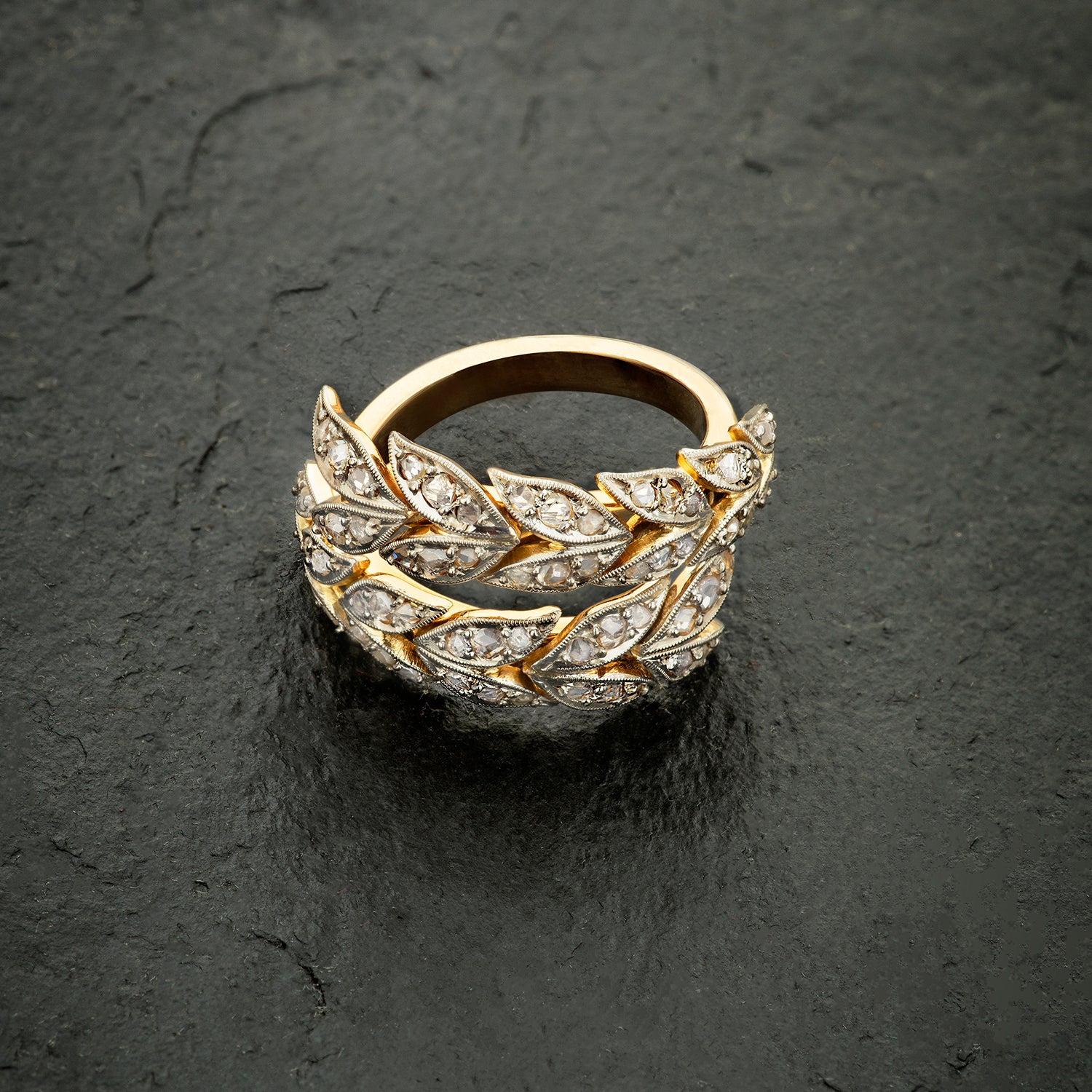
It is a request we hear more and more often from clients: a desire to weave personal sentiments into the details. People are once again seeking rings that look and feel like theirs - not cookie-cutter designs, but keepsakes. Through the years we have designed many engraved wedding bands and engagement rings at Lebrusan Studio, and no two have ever been the same. Hand-adorned by our master engraver Darren in London’s historic Hatton Garden, our signature designs mostly bear organic, nature-inspired motifs or Art Nouveau-style scrolls - but our archive of bespoke commissions also includes custom engravings of geographic coordinates, initials, dates and symbols.
HAND ENGRAVED JEWELLERY: THE PROS AND CONS

Our iconic Wriggle Scrolls motif hand-engraved onto two Scrolls wedding bands, our vintage-inspired Hearts motif hand-engraved onto a bespoke engagement ring, our Vines wedding band in various widths and colours
At Lebrusan Studio, we’re passionate about exquisite craftsmanship and championing the skilled craftspeople responsible for it. We believe that human beings are vessels of cultural heritage and the only possible means by which knowledge and tradition can continue to be passed down from one generation to the next. That's why 100% of our jewellery created in the UK, primarily in small family-run workshops in London’s jewellery quarter, Hatton Garden. Venturing down into Hatton Garden’s labyrinth of underground workshops would lead you to Darren, our master hand engraver. Upheld by years of experience he carefully inscribes patterns and messages into our jewellery using traditional handheld tools like drills and gravers no larger than a pencil nib.
The pros:
- Unmatched intricacy. Hand engraving using hardened steel tools can create extremely detailed and intricate designs that are difficult or impossible to replicate with modern technology. No two hand-engraved designs are identical, making each of Darren’s projects a truly unique work of art.
- Creative freedom. Hand engravers like Darren can directly control the depth and width of their cuts, affording them a broad stylistic range and the freedom to adapt and experiment throughout the process.
- Smoother finish. Since hand engraving works by gently removing volumes of metal, the finished surface is generally smoother to the touch than jewellery marked by more mechanically precise methods like laser engraving - which, in some instances, makes hand-engraved jewellery a little more resistant to wear and corrosion over time.
- An investment in living craft. Choosing a piece of hand-engraved jewellery is investing in the future of a British jewellery tradition, enabling a highly skilled artisan like Darren to continue fulfilling his talent and sustaining a legacy. When we first began offering hand-engraved engagement rings and wedding bands over a decade ago, our hope was to revive this ancient art form and establish a conversation around the importance of upholding traditional craftsmanship. It has been deeply rewarding to see slow, deliberate artisanship become synonymous with Lebrusan Studio.
The cons:
- Time. Hand engraving is a laborious technique that takes considerably longer than machine-driven engraving, particularly for large pieces or exceptionally intricate designs. This is worth bearing in mind if your project is time-sensitive.
- Organic rather than uniform. Uniformity cannot be guaranteed. For many, the beauty of hand engraving lies precisely in its organic uniqueness. If your vision requires absolute precision or you need to match another piece of jewellery like-for-like, however, a more exact method may serve you better.
- Cost. Hand engraving is generally the most expensive engraving method. That said, unlike machine-driven approaches, paying for a hand engraving means paying for a human being, their rare skills and their time - which is perhaps money better invested.
LASER ENGRAVED JEWELLERY: THE PROS AND CONS
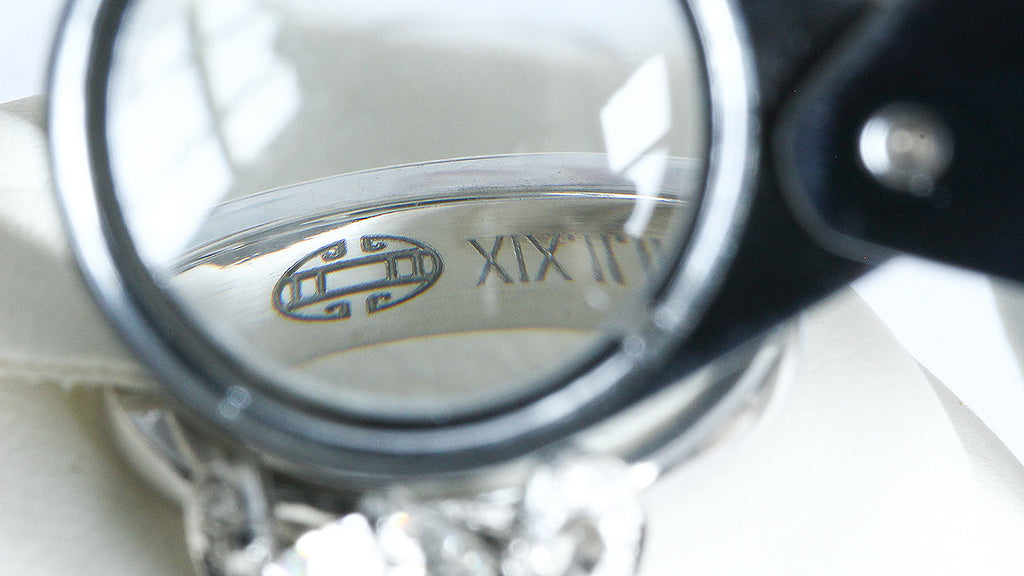
 A pair of bespoke commitment rings, laser-engraved with unique emblems
Laser engraving uses a highly concentrated laser beam - the thickness of which affects the thickness of the engraving itself. Either freehand or attached to a machine, it works similarly to how a pencil moves across paper and can be focused as necessary to create detailed images or patterns.
Sometimes we call on laser engraving when a design requires fine detail and a sense of symmetry that could not be achieved by hand. The result is clean and contemporary - a compelling counterpart to the organic character of hand engraving.
We love that the two approaches can coexist: ancient craftsmanship alongside modern technology, each serving its own purpose in the service of personal storytelling.
The pros:
- Precision. Since the laser does all of the work once a design has been finalised, there is less room for human error.
- Crispness. Laser engraving produces the cleanest and sharpest finish of all engraving methods. This level of precision allows for incredibly fine lines and tiny lettering, making it possible to engrave even the thinnest of bands.
- Replicability. Since designs are created digitally, it is possible to realise a specific font, logo or image file as an engraving. This also enables designs to be perfectly replicated across numerous pieces of jewellery.
The cons:
- No human touch. Where laser engraving excels in precision, it lacks in personal touch. Opting for a laser does not enable us to support independent craftspeople, nor to create truly unrepeatable pieces of jewellery.
- Environmental cost. Laser engraving machines require a considerable amount of energy to run, carrying a far larger environmental footprint than hand engraving.